
After a pronounced but short-lived period of euphoria, marked by the $85.7 billion debut offering of SpaceX and the $26.5 billion offering of American depositary receipts by SK Hynix, the marketplace for IPOs has experienced its first signs of congestion.[1] In the last 10 days, nuclear services firm Holtec Nuclear ($0.9 billion), data-center developer SB Energy (up to $7.0 billion) and home insurer Bamboo Insurance ($0.7 billion) have shelved their offerings.[2] The slowdown is further reflected in the broader data. Of the more than two dozen companies that have publicly filed with leading U.S. investment banks since July 31, only 9 have gone public, including 4 in September when proceeds of $0.7 billion (see Figure 1) mark the smallest sum for the calendar month since at least 2017. While delays are not infrequent on a standalone basis, a slate of entities is rarely sidelined unless the IPO market is on the precipice of closing itself to new listings. This is a concern.
Figure 1. US IPO Proceeds, Filings and Pricings by Month
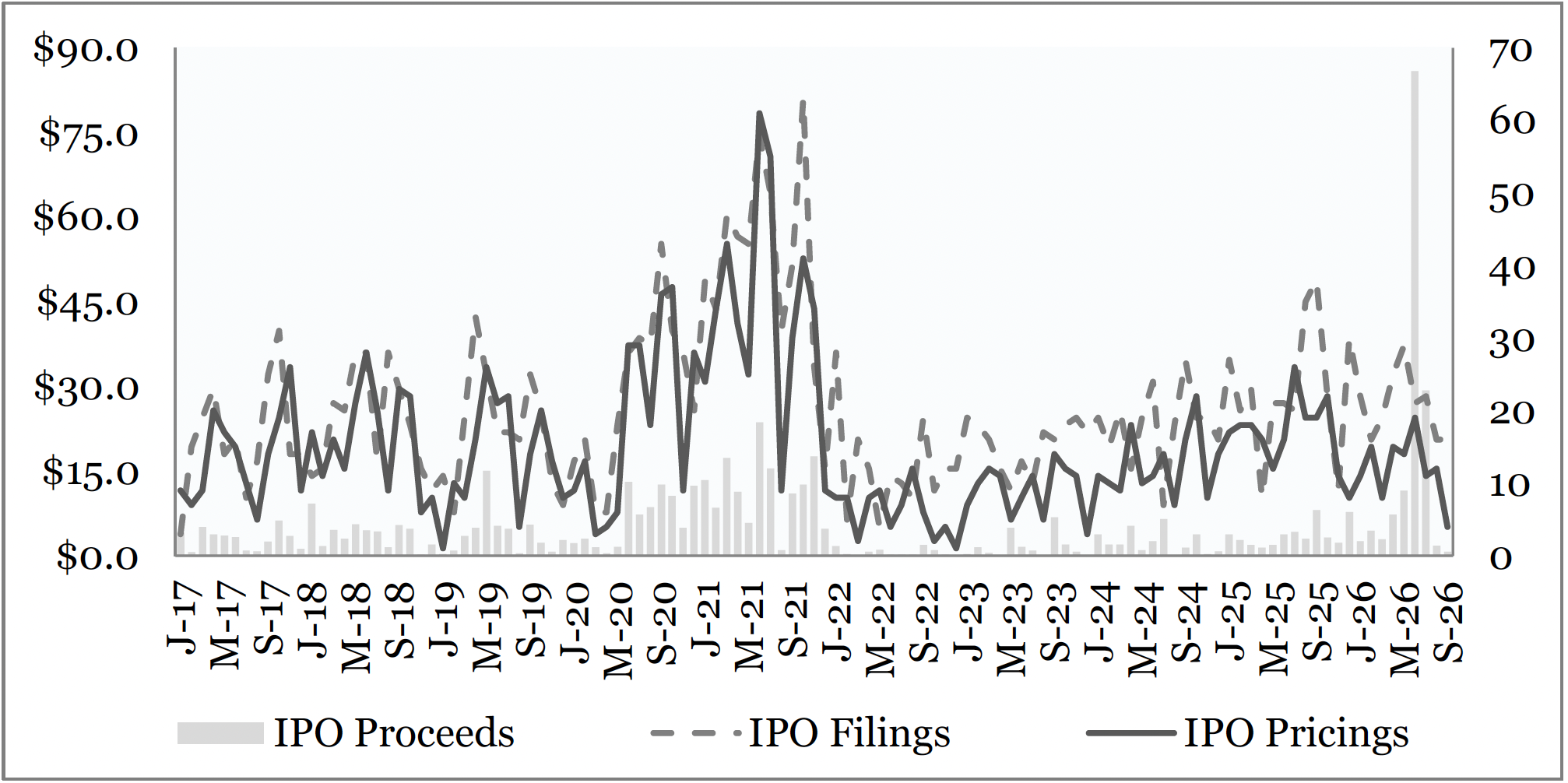
Source: Renaissance Capital.
No small item, the potential shuttering of the IPO window is being highlighted here because it represents a forward indicator of a market downturn.[3] Indeed, recognizing the obvious success of one-off listings, such as Facebook (2012), Alibaba (2014), Snap (2017), and Spotify (2018), it is equally true that history has yet to witness an IPO boom that did not descend into a material decline in the major indices.[4] Putting aside the South Sea Bubble (1720) and the Gründerzeit (1872), where the data is supportive of the configuration but imperfect, one finds IPO booms not only peaking in unison with major stock price indexes but also foretelling stock price declines exceeding 40% in connection with the Depression of 1920-21, Great Crash (1929), Recession of 1937, and Bear Market of 1973-74, just as the relationship is expressed during the Japanese Asset Bubble (1990) and Dotcom Bubble (2000). Indeed, had an investor in the Nasdaq acted on this knowledge and exited their holdings when an IPO cliff presented itself in November 2021, a drop of 36.4% would have been averted in the ensuing 13 months.[5]
Far more than coincidence, the outsized price decline in these episodes is, simply, explained by an unavoidable crowding out that occurs at the end of an economic cycle when floodtides in the new issues market must, necessarily, be met with the sale of other securities. Consistent with an imbalance of supply and demand, a proliferation of IPOs is comparable to a liquidity shock that overruns the marginal buyer in the stock market. Where most stock market bubbles have been accompanied by government surpluses, upturns occurring during periods of government deficits, such as in 1919, 1937, and 1973, have also exposed stock prices to competition from long-term U.S. Government securities that, in each case, closed out the IPO market altogether. Such is the set-up today.
With the danger made clear, it must be plainly stated that the current slowdown does not portend an imminent shutdown of the IPO market. Instead, the congestion is reflective of the extraordinary size of the current cluster of IPOs, and, more specifically, the forthcoming offering by Anthropic that, by some estimates, is expected to raise $100 billion at a valuation of $2 trillion.[6] By comparison, the $78.2 billion of IPO proceeds raised in 2020 was scattered across 268 companies and the $142.4 billion in 2021 was dispersed across 486 organizations.[7] Set against SpaceX in June, the offering from Anthropic in November will form a tent-pole event, whose profile – like a tsunami – depends on a temporary depression in volumes. Yet, at the same time, the presence of congestion in the IPO market today indicates that a third tidal wave is unlikely to appear on the back end of what stands to be the largest such offering on record. After all, the decision to shelve a registration filing is not taken lightly by management teams, who are well aware that only ~13% of withdrawn filings successfully return to the IPO market.[8]
For those in doubt, one need only consider the market for long-term U.S. Government securities, where the rapid rise in yields, including the 10-year that, at 5.21%, rests at the highest level since 2007, has prompted the U.S. Treasury to support prices by utilizing government deposits (received from tax revenues) of up to $4.0 billion in periodic buyback operations.[9] While extraordinary, actions to support the long-term market for U.S. Government securities have occurred not infrequently since the advent of the Federal Reserve Banks. Though effective in wartime or when used as an economic stimulus during recessions, as in 1958, 1961, 2009 and 2020, every other attempt by the Treasury or the Fed to support long-term U.S. Government securities has also ended badly for stock prices.[10] As it is, the pattern was observed in March 1937, when the Treasury was compelled to provide support at the front of a 49.1% decline in the DJIA.[11] It was also evident in 1965, when the Treasury turned to government trust accounts under its authority to buy U.S. Government bonds to “prevent long-term rates from rising,” in advance of a 25.2% decline in 1966.[12] Further intervention followed in 1968 and 1973, when the DJIA fell 35.9% and then 45.1%, respectively.[13] More recently, the Nasdaq peaked on March 10, 2000, a day after the Treasury’s first debt buyback in 70 years, and went on to lose 77.9%.[14]
An inescapable relationship, the idea that intervention in the market for long-term U.S. Government securities during economic expansions is predictive of stock price declines fits neatly within the core tenets of corporate finance elucidated by John Burr Williams, who defined the value of stock prices by discounting their future dividends at a rate anchored to the long-term government yield.[15] Once brought forward, it is obvious that any acquisition of long-term U.S. Government securities intended to maintain the present yield is a concession that new issues will only clear the marketplace at higher yields. Meanwhile, the firepower of the Treasury is limited to the perceived surplus in its depositories, which is some $400 billion above the level targeted under the prior administration.[16] And once that surplus is spent, Secretary Scott Bessent, who recently declared “I am the house now,” is almost certain to sound like his predecessor Henry Morgenthau Jr., who in 1937 conceded that “nobody has enough money to put the market up or down.”[17]
Taken together, one is left with the distinct impression that the IPO market will close on the back end of the Anthropic offering in November. Were the historical record to dictate the future, one supposes the competition for capital will force rates higher, drawing funds away from stock prices. Contrasted with stock market bubbles in 1929, 1990, and 2000, when budget surpluses acted as a source of funds, the presence of an outsized U.S. deficit has introduced a competition for capital that necessarily means the IPO boom will be relatively short. Because of this factor, the best comparable to the present is the Bear Market of 1973-74, when activity in the new issues market was effectively sidelined by a spike in the long-term rate for U.S. Government securities, such that the peak in the DJIA, uniquely, occurred in the month before IPO volumes reached the same milestone. When applied to the present, the implication is that a market top is forming. The Nasdaq may yet exceed its high of 27,244 on September 22, but the peak it sets could very well go uneclipsed for 1,500 days.
As an initial step, investors would do well to remember the wisdom of Benjamin Graham, who, while skeptical of market timing, favored reducing equity allocations (from 50%) to 25% when the dividend yield on the DJIA fell below 2/3 of the yield on bonds.[18] Fortunately, an obvious point of rotation in the interim exists in 3-month U.S. Treasury bills, which are currently yielding 4.2%.[19] If this security is held until the peak in stock prices is understood – and the downward pressure on the yellow metal from central bank policy is eliminated – before it is exchanged for gold, an investor can circumvent the market tumult with a moderate risk-free return and attain an attractive entry point into the metal that may very well rise into the stratosphere. Given the tendencies in place, it is not unreasonable to assume the growth in gold prices will resemble the 2.9x rise observed during the Bear Market of 1973-74. For anyone still slow to move, further clarity can be found in the investment advice imparted by Edwin Lefèvre, who conveyed: “One of the most helpful things that any body can learn is to give up trying to catch the last eighth – or the first. These two are the most expensive eighths in the world.”[20]
Charles Lister Smith, PhD
September 29, 2026
[1] CNBC, “SpaceX IPO Raises Total of $85.7 Billion as Underwriters Exercise ‘Greenshoe’ Overallotment Option,” June 15, 2026; J. Ye-eun, “SK Hynix Sets Foreign IPO Record with $26.5 Billion Nasdaq Offering,” The Korea Herald, July 10, 2026.
[2] Bailey Lipschultz and Anthony Hughes, “Derailed IPO Plans Rattle US Market Ahead of Anthropic Debut,” Bloomberg, September 22, 2026.
[3] See a forthcoming paper, “Architecture of a Bubble,” that is to be released next month by this author.
[4] E.M. Rusli and P. Eavis, “Facebook Raises $16 Billion in I.P.O.,” New York Times, May 17, 2012; N. Gough, “Alibaba I.P.O. Underwriters Increase Deal Size to Record-Setting $25 Billion,” New York Times, September 22, 2014; M. de la Merced, “Snap Prices I.P.O. at $17 a Share, Valuing Company at $24 Billion,” New York Times, March 1, 2017; and B. Sisario and M. Phillips, “Spotify’s Wall Street Debut Is A Success,” New York Times, April 3, 2018.
[5] Federal Reserve Bank of St. Louis.
[6] S. Muppidi, L. Hirsch, and E. Griffith, “Anthropic Could Aim to Raise $100 billion in Blockbuster I.P.O,” New York Times, August 21, 2026; C. Driebusch, A. Gardizy, and K. Clark, “Anthropic Shifts Planned IPO to November,” Wall Street Journal, September 17, 2026.
[7] Renaissance Capital, US IPO market data.
[8] Kevin K. Boeh and Craig G. Dunbar, “Post IPO Withdrawal Outcomes,” December 23, 2013, 1. https://ssrn.com/abstract=2135772.
[9] U.S. Department of the Treasury, “Treasury Announces Increased Sizes of Nominal Long-End Liquidity Support Buybacks Beginning September 9,” press release, August 19, 2026. https://home.treasury.gov/news/press-releases/sb0607.
[10] Jessie Romero, “The Treasury-Fed Accord,” Federal Reserve History. https://www.federalreservehistory.org/essays/treasury-fed-accord; Kenneth D. Garbade, “Beyond Thirty,” Federal Reserve Bank of New York Staff Report 806, January 2017, 12f. https://www.newyorkfed.org/medialibrary/media/research/staff_reports/sr806.pdf.
[11] Federal Open Market Committee, Minutes of Meeting, March 15, 1937, 40. https://fraser.stlouisfed.org/docs/meltzer/omc_031537.pdf; E. A. Goldenweiser, American Monetary Policy (McGraw-Hill, 1951), 180; Eugene S. Duffield, “Most of Federal Trust Funds Used in Bond Buying,” Wall Street Journal, March 31, 1937, 1, 4.
[12] Kenneth D. Garbade, After the Accord (Cambridge University Press, 2021), 4–5; “Capital Markets: Large Supply Depresses Corporate and U.S. Bonds,” Barron’s, August 9, 1965, 22.
[13] Robert Van Cleave, “Capital Markets: Official Demand for Funds Depresses Price of Bonds,” Barron’s, March 25, 1968, 37; Robert D. Hershey Jr., “Bids Fall Short on U.S. Bond Issue,” New York Times, August 2, 1973, 49, 56.
[14] Kenneth D. Garbade and Matthew Rutherford, “Buybacks in Treasury Cash and Debt Management,” Federal Reserve Bank of New York Staff Report 304, October 2007, 7; “Statement by the President on Debt Buyback,” The White House, March 9, 2000, 510–11. https://www.govinfo.gov/content/pkg/WCPD-2000-03-13/pdf/WCPD-2000-03-13.pdf.
[15] John Burr Williams, The Theory of Investment Value (Harvard University Press, 1938).
[16] Louis Juricic, “Treasury’s $950B Cash Account Seen Funding Bond Buyback Surge,” Investing.com, August 24, 2026.
[17] CNBC, “Bessent Bond Plan Details to Be Revealed as Treasury Secretary Warns FX Traders He’s ‘the House Now,’” September 9, 2026; “Morgenthau Seeks ‘Orderly’ Market,” New York Times, April 2, 1937, 33.
[18] Benjamin Graham, The Intelligent Investor (Harper & Row Publishers, 1973), 96, 43.
[19] Federal Reserve Bank of St. Louis.
[20] Edwin Lefèvre, Reminiscences of a Stock Operator (Larchmont, NY: American Research Council, [1964]; orig. George H. Doran, 1923), 65.