
The first speculative episodes centered on stocks – the Mississippi Bubble and South Sea Bubble – unfolded in rapid succession on either side of the English Channel between 1719-20. In both instances, the market displacement emanated from government schemes to convert debts incurred during the War of the Spanish Succession into publicly traded stocks that were endowed with valuable trading privileges in overseas colonies that, initially, justified the rising price environment. Both ended badly.
Originating first in Paris, the Mississippi Bubble arose from a debt program, famously arranged in 1719 by John Law. A Scotsman who had fled to the Continent after a duel, Law organized the Banque Royale and the Compagnie des Indes (or Mississippi Company), which held the right to the collection of indirect state taxes (for an annual payment of 52 million livres) along with monopoly trading privileges in France’s overseas territories that spanned from West Africa to the Americas and Asia.[1] To reduce the burden of the French debt, which had swelled to a face value of 2.3 billion livres, Law arranged a conversion of approximately 1.5 billion livres of the national debt into shares of the Mississippi Company. In turn, the entity issued 50,000 shares on an installment basis at a price of 550 livres in June 1719, before replicating the offering in the following month with an issue of 50,000 shares at 1,000 livres.[2] In all, the Mississippi Company counted 300,000 shares at the end of July 1719, when its share price stood at 1,960 livres.
Capitalizing on the moment, in the 5 weeks from September 12, the Mississippi Company made 3 additional issues of 100,000 shares each at a price of 5,000 livres with upfront installment payments of 500 livres, bringing its total share count to 600,000.[3] This activity was supported by the Banque Royale, which expanded its notes outstanding from 160 million livres to a remarkable 769 million during the last 5 months of 1719.[4] Tantamount to an increase in the nation’s money supply, the sudden expansion in currency contributed to a doubling in the entity’s share price that peaked at 10,000 in November 1719, when its market value, at 6.0 billion livres, equated to 4.0x the amount of debt converted in the transaction.[5]
With its share price weakening by 5.9% to 9,413 by the end of December 1719, the Mississippi Company issued, in the following month, call options, or ‘primes,’ with a strike price of 10,000 livres that ultimately expired worthless six months later.[6] Stimulating activity further in the initial two months of 1720, the Banque Royale augmented its note base by 301 million livres, an increase of 39.1%, in connection with its merger into the Mississippi Company on February 22 that also consisted of the acquisition of 100,000 shares, or 16.7% of the total, from the King of France at a price of 9,000 livres.[7] However, with support at 9,925 livres halted the same day, the entity’s share price plunged 14.4% (to 8,500 livres) in the week to March 1.[8]
Reversing course on March 5, Law acted to avert a price collapse with a two-pronged plan that (i) pegged the share price at 9,000 livres by purchasing obligations at the stated price and (ii) converted the outstanding subscriptions into full shares by waiving installments of 3,000 livres per share, such that 900 million livres of stock was effectively delivered against nothing. While removing the turnover associated with future installment payments, which represented a liability and therefore an incentive to sell, the decision also activated the entire lot of shares that otherwise would have suffered some attrition because of their forfeiture when installments went unpaid. In other words, by removing the installment pledge, Law stimulated supply rather than demand. Against the resultant flood tide of sellers, Law acquired 27% of the public float of the Mississippi Company at a cost of 1.2 billion livres in the 3 months from March, expanding the note base of the Banque Royale to 2.1 billion livres by May 22. Thus, to maintain a share price of 9,000 livres, the Mississippi Company had, absurdly, forced a near doubling in the note base of the Banque Royale.[9]
In what amounted to a recognition of the imbalance of supply over demand, Law attempted, in his final act, to engineer an orderly price decline by issuing an arrêt in May 1720 that contemplated a step-down reduction in the official price of the Mississippi Company to 5,000 livres, a drop of 44.4%, alongside a comparable decline in the notes outstanding of the Banque Royale.[10] However, instead of being phased in over a matter of months, the former traded to 4,200 livres within the week, when the share price reflected a 58% decline from the peak level recorded 6 months prior. Dismissed on May 28, Law ended his days in obscurity as a professional gambler in Venice. Thus, despite the limitations of data and the unique participation of a central bank in a company scheme, it is obvious that the Mississippi Bubble was the product of an over-issuance of securities. All else equal, a price collapse is the mechanical outcome of a material expansion in supply. That the Mississippi Company was resurrected only after the Visa of 1721 lowered its share count to 56,000, a 91% reduction from the 600,000 shares a year prior, underscores the point.[11]
Concurrently, the early success of treasury activities in France spurred the South Sea Act (1720) in the U.K., which, as the victor, had emerged from the War of the Spanish Succession with valuable trading rights along with the territories of Gibraltar, Minorca, Nova Scotia, Newfoundland, and Hudson Bay that offset some of the burden imposed by its expanded national debt that had grown by 67.2% in the prior decade to reach £59.2 million in 1720.[12] Sponsored by the Chancellor of the Exchequer, John Aislabie, the Act established the terms for a debt-to-equity conversion of £26.3 million, or 44% of the national debt in 1720, which was swapped into shares of the South Sea Company that was endowed with recently minted trading privileges. To facilitate the conversion, the South Sea Company made four offerings, beginning in April 1720, when £6.8 million of shares were sold at £300 on an installment basis with 20% paid upfront.[13] Within 15 days, the entity offered an additional £6.0 million of shares at £400 with 10% down, such that the one-third increase in share price was met with a comparable decline in the upfront cash required to secure the obligation.[14] What could go wrong?
Figure 1. Performance of U.K. Stocks (1719-1722)
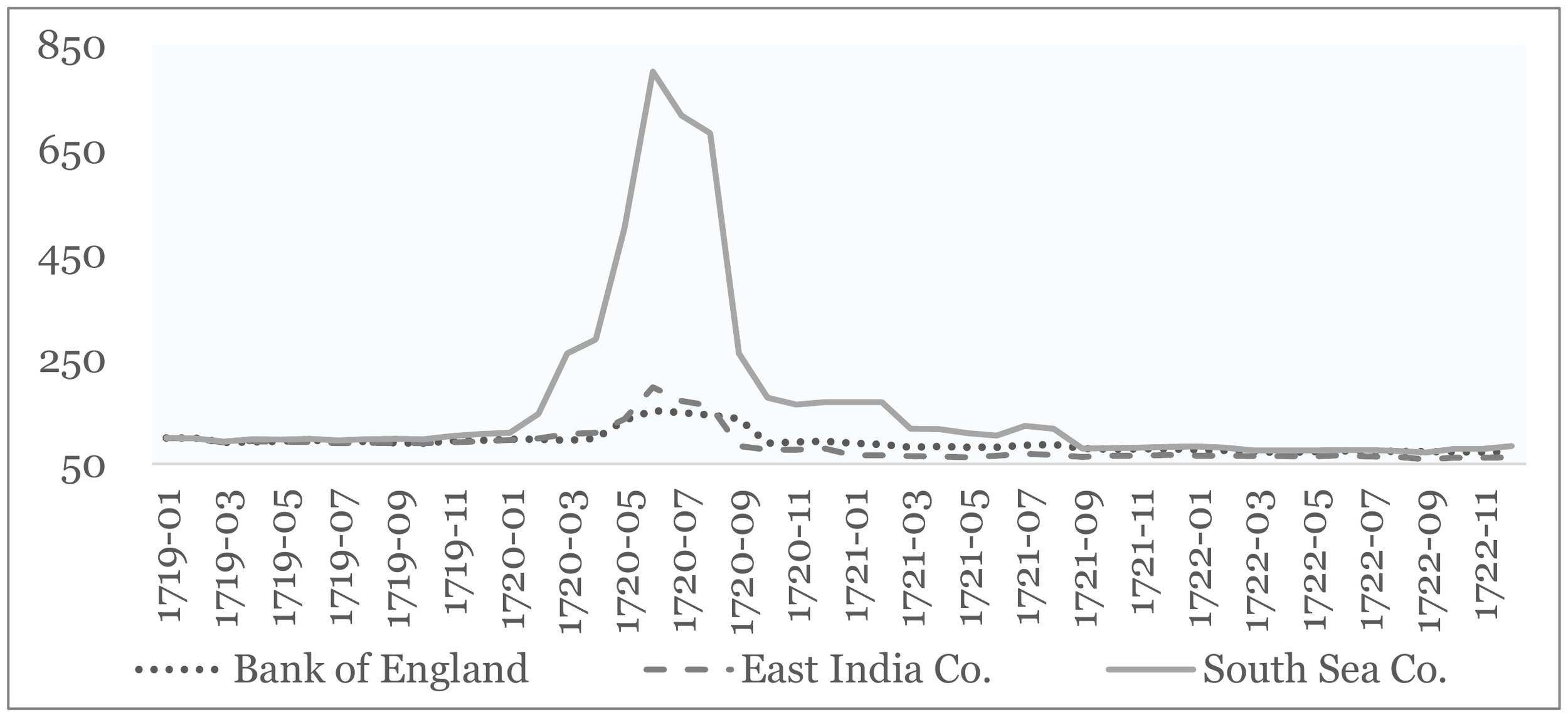
Source: Larry Neal (1990, 234-235). Figures indexed to 100 in January 1719.
Contrasted with the upswell in France that was fixed on a single entity, the boom in U.K. stocks extended beyond the South Sea Company to include approximately 200 flotations, of which only four represented ongoing businesses after the tumult.[15] Meanwhile, in the initial 25 weeks of 1720, the share price of the East India Company (see Figure 1) gained 70%, and the Royal African Company surged 483%.[16] So intense was the competition for capital that the U.K. Parliament passed the Bubble Act (1720), which barred the formation of joint-stock companies without a royal charter.[17] This legislation created a predictable tailwind for the South Sea Company, which offered £5 million of stock at £1,000 with a 10% upfront payment in June 1720.[18] On its heels, the entity’s share price peaked at £1,060.[19]
Having closed its books for record-keeping purposes for more than a month, when the entity’s shares did not officially trade, the South Sea Company made a fourth and final money subscription on August 24, offering £1.25 million of stock at £1,000 per share with an upfront payment of 20%. Pro forma for this activity, the four subscriptions amounted to £75.3 million, an amount 27.1% larger than the U.K. national debt. However, on average, only 14% of the sum (see Figure 2) was paid upfront, while the remainder was funded in scheduled installment payments that increasingly became due. As such, the offering on August 24 was sequenced 10 days after a scheduled payment on the first subscription and 21 days before an installment on the second subscription fell due.[20]
Figure 2. Offering Terms of the South Sea Company in 1720
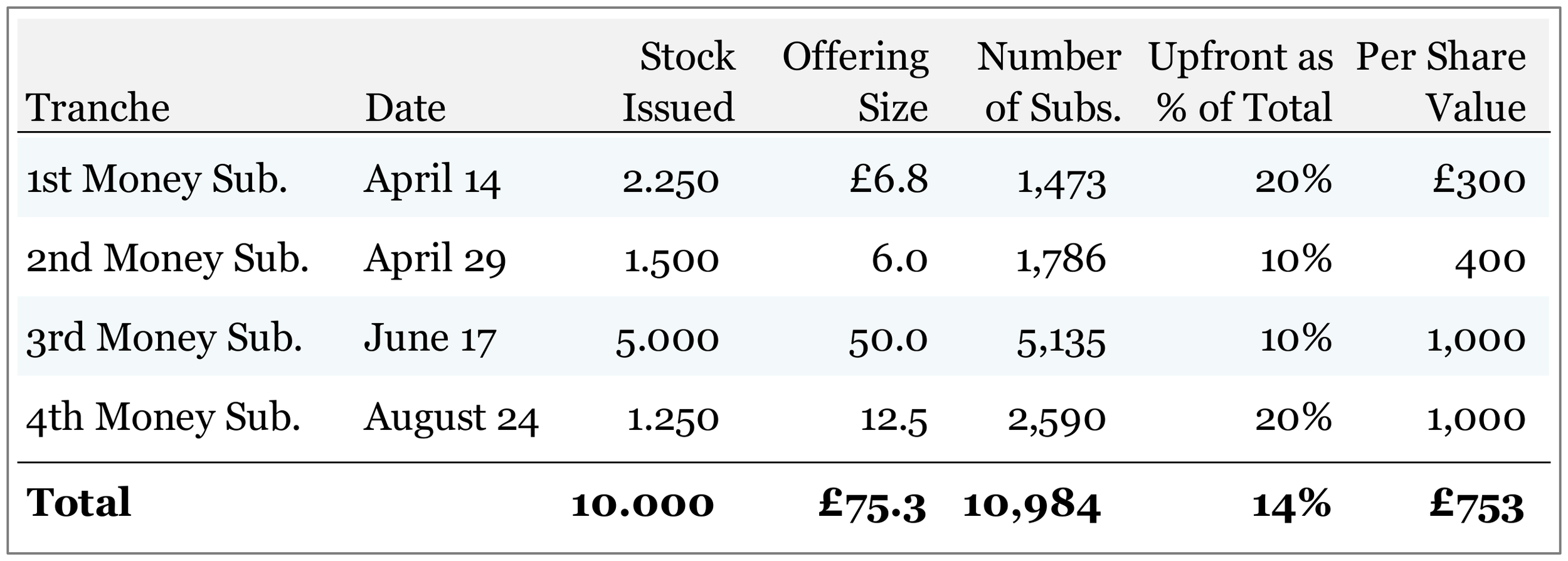
Source: Julian Hoppit, “The Myths of the South Sea Bubble,” Transactions of the Royal Historical Society, vol 12 (2002), 150.
With such great sums already pledged, the supply increase associated with the fourth money subscription had an immediate impact on the share price of the South Sea Company. Tumbling to £755 on August 30, the entity’s share price descended to £575 on September 9, before falling to £190 on September 28, when the price level reflected an 82.1% drop in under 4 months.[21] While certain lenders, such as Hoare's Bank, pulled commitments beginning in April 1720, it is noteworthy that the price collapse was unaccompanied by any widespread withdrawal of credit, nor has the episode been ascribed to questions of investor psychology.[22] Instead, the South Sea Bubble ruptured when the secondary market could not clear the expanded public float of shares.
Easily dismissed as antiquated on a standalone basis, the Mississippi and South Sea Bubbles remain relevant because the episodes established a well-worn pattern. Following a market displacement that activated dormant securities, stock prices are observed surging to meteoric levels in both cases. Having been driven upward on a limited public float, the investor demand supporting stock prices was, quite clearly, overrun by an expansion in supply. And if stock price crashes do not occur when the marginal buyer is overrun by supply, then how to explain the phenomenon?
Charles Lister Smith
September 10, 2026
[1] Peter M. Garber, Famous First Bubbles (MIT Press, 2000), 96.
[2] François R. Velde, "Government Equity and Money: John Law’s System in 1720 France," Federal Reserve Bank of Chicago Working Paper 2003-31 (2003), 8, 17-18, 29; Garber, Famous First Bubbles, 96.
[3] Garber, Famous First Bubbles, 97; Velde, "Government Equity and Money," 17-18, 29.
[4] Velde, "Government Equity and Money," 25.
[5] Velde, "Government Equity and Money," 16, 29.
[6] Richard Dale, The First Crash (Princeton University Press, 2004), 125-26.
[7] Velde, "Government Equity and Money," 25, 29.
[8] Velde, "Government Equity and Money," 30.
[9] Velde, "Government Equity and Money," 18, 25, 30. Velde attributes the episode to monetary factors, with the expansion in notes as the operative variable, and does not consider the growth in the supply of shares.
[10] Dale, The First Crash, 126; Velde, "Government Equity and Money," 30.
[11] Velde, "Government Equity and Money," 40.
[12] Federal Reserve Bank of St. Louis (FRED).
[13] Julian Hoppit, "The Myths of the South Sea Bubble," Transactions of the Royal Historical Society 12 (2002): 150.
[14] Ibid.
[15] Dale, The First Crash, 107.
[16] Ibid.
[17] Bubble Act 1720, 6 Geo. I, c. 18.
[18] Hoppit, "Myths of the South Sea Bubble," 150.
[19] W.R. Scott, The Constitution and Finance of English, Scottish and Irish Joint-Stock Companies to 1720 (Cambridge University Press, 1912), 321.
[20] François R. Velde, "Britain's Debt Restructuring, 1717–22," Federal Reserve Bank of Chicago Working Paper 2025-21 (2025), 20.
[21] Scott, Constitution and Finance of Joint-Stock Companies, 325-26, 328.
[22] Peter Temin and Hans-Joachim Voth, "Riding the South Sea Bubble," American Economic Review 94, no. 5 (December 2004): 1665.