
The Great Recession arrived at the end of a credit boom that was extended by the presence of what Ben Bernanke described as a global ‘savings glut.’[1] Estimated at $5 trillion and credited to oil-exporting Arab nation-states and China, these funds enabled the Federal Reserve to pursue an unprecedented reduction in the discount rate, which was lowered (from 6.00 percent) to 0.75 percent in the two years ending December 2002.[2] However, as the boom increasingly took hold, the competition for capital was expressed (see Figure 1) in a stunning rise in market yields that was matched by a lifting in the Federal Funds Rate.[3] Tracking the experience in other speculative upswells, heightened lending costs were not felt in gross domestic product, which grew 28.9% from $11.5 trillion in 2003 to $14.8 trillion in 2008.[4]
Figure 1. U.S. Market Yields vs. S&P 500 Index
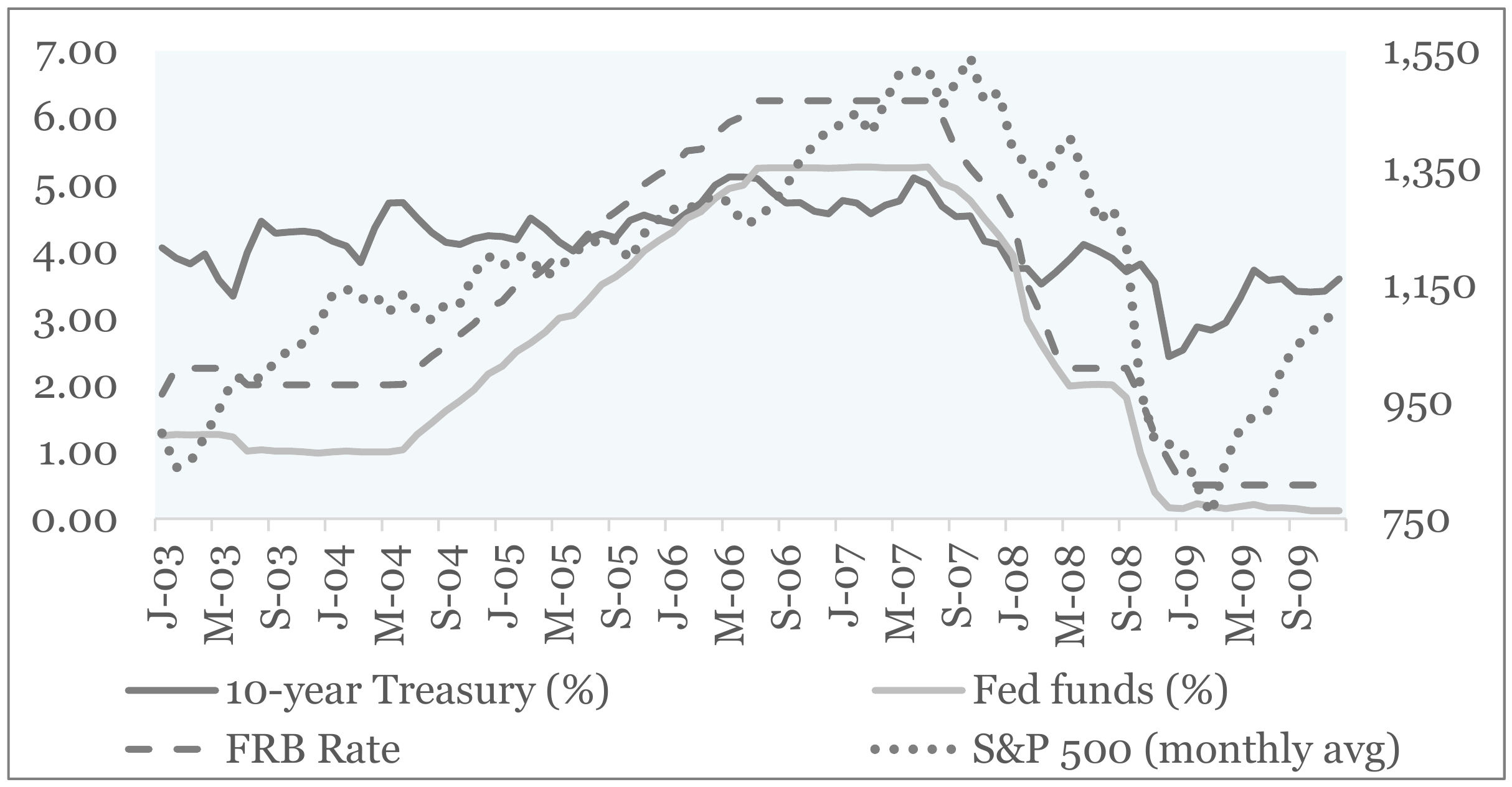
Source: Federal Reserve Bank of St. Louis.
The abundant amount of funds made available for risk-free securities was met with financial innovation in the new issues market, where investment bankers introduced asset-backed securities (ABS) that mitigated single-security risk by packaging loans en masse to provide a layer of diversification.[5] Seemingly slight, the invention was absorbed with alacrity in the U.S. housing market, where (see Figure 2) mortgages for 1-4 family homes surged from $743 billion in 2004 to $2.3 trillion in June 2007. Compounding matters, underwriters repackaged approximately $556 billion of the lowest-performing of these mortgages into collateralized debt obligations (CDOs) that received improved rating grades on account of the added diversification.[6] Consequently, subprime mortgages were effectively written up (from BBB to AAA) to ratings deemed ‘safe’ for depository institutions. Harnessing the same concept, underwriters unveiled collateralized loan obligations (CLOs) principally geared towards the leveraged buyouts of private equity firms. Coincidentally, the volume of such transactions reached $535 billion in the four years ending 2007, up from $50 billion in the eight years through 2003.[7]
Figure 2. U.S. Asset-Backed Securities
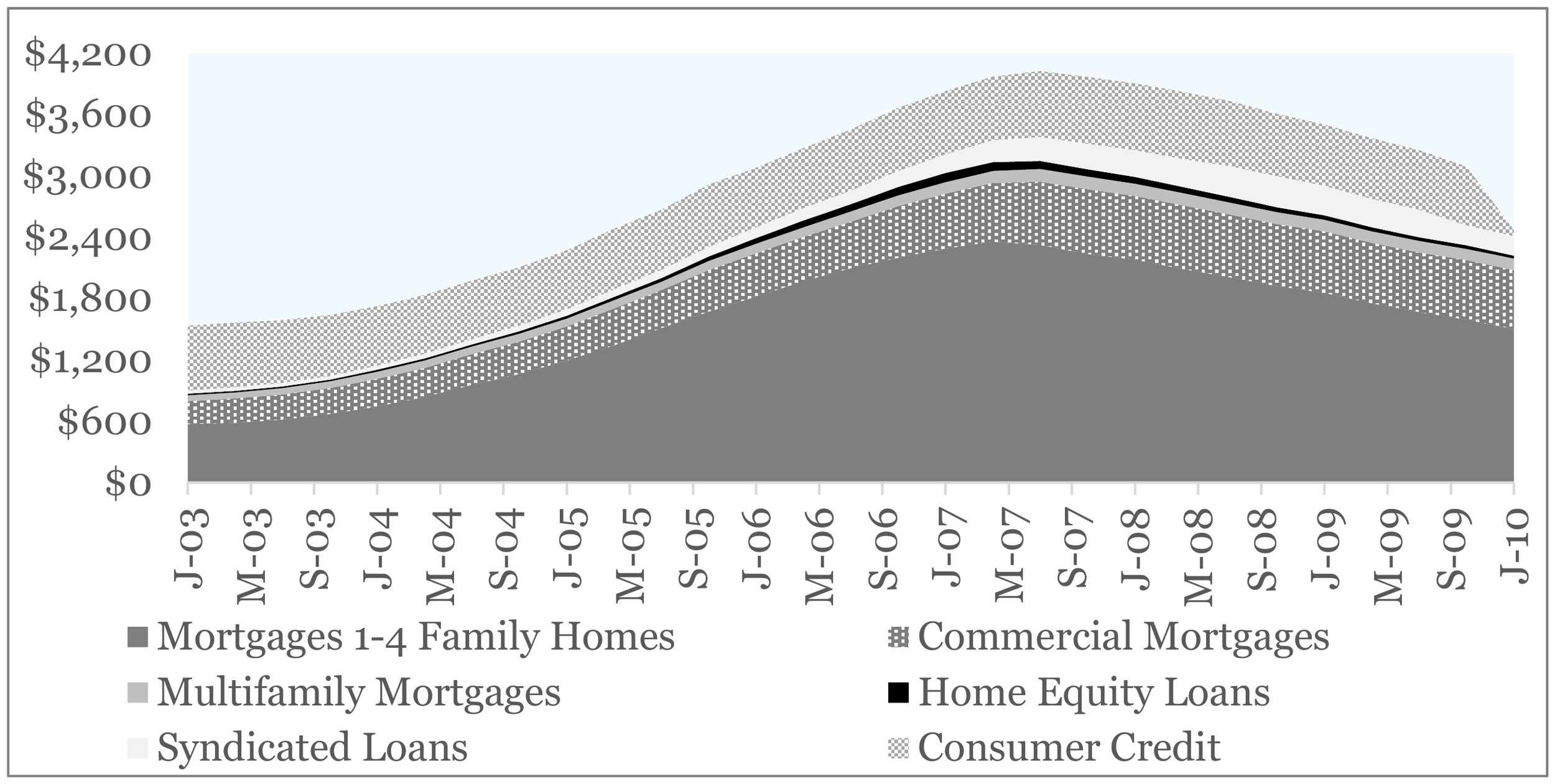
Source: Federal Reserve Bank of St. Louis.
In hindsight, the first sign of the impending crisis arrived in June 2007, when Bear Stearns revealed the closure of two internal hedge funds, which had taken highly leveraged positions in subprime mortgages that were put under pressure by rising delinquencies.[8] Newfound concerns regarding a “credit crunch” were given meaning on July 18 by Jamie Dimon, the CEO of J.P. Morgan, who described “a little freeze” in the debt markets while disclosing the firm was responsible for $11 billion of “hung bridges” related to leveraged buyouts.[9] Following similar statements from U.S. banks, the overhang of pipeline commitments to private equity concerns was quickly put at $300 billion.[10] As unsold commitments accumulated, mounting mortgage delinquencies combined with falling house prices to place the underlying securities deeply underwater. The result, hitherto reckoned impossible, was that AAA-rated securities suffered total losses, and financial intermediaries were compelled to hoard capital and withdraw lending to the real economy. In turn, systemic liquidation was required to restore balance sheets.[11]
Figure 3. S&P 500 Index vs. Volume (billions of shares)
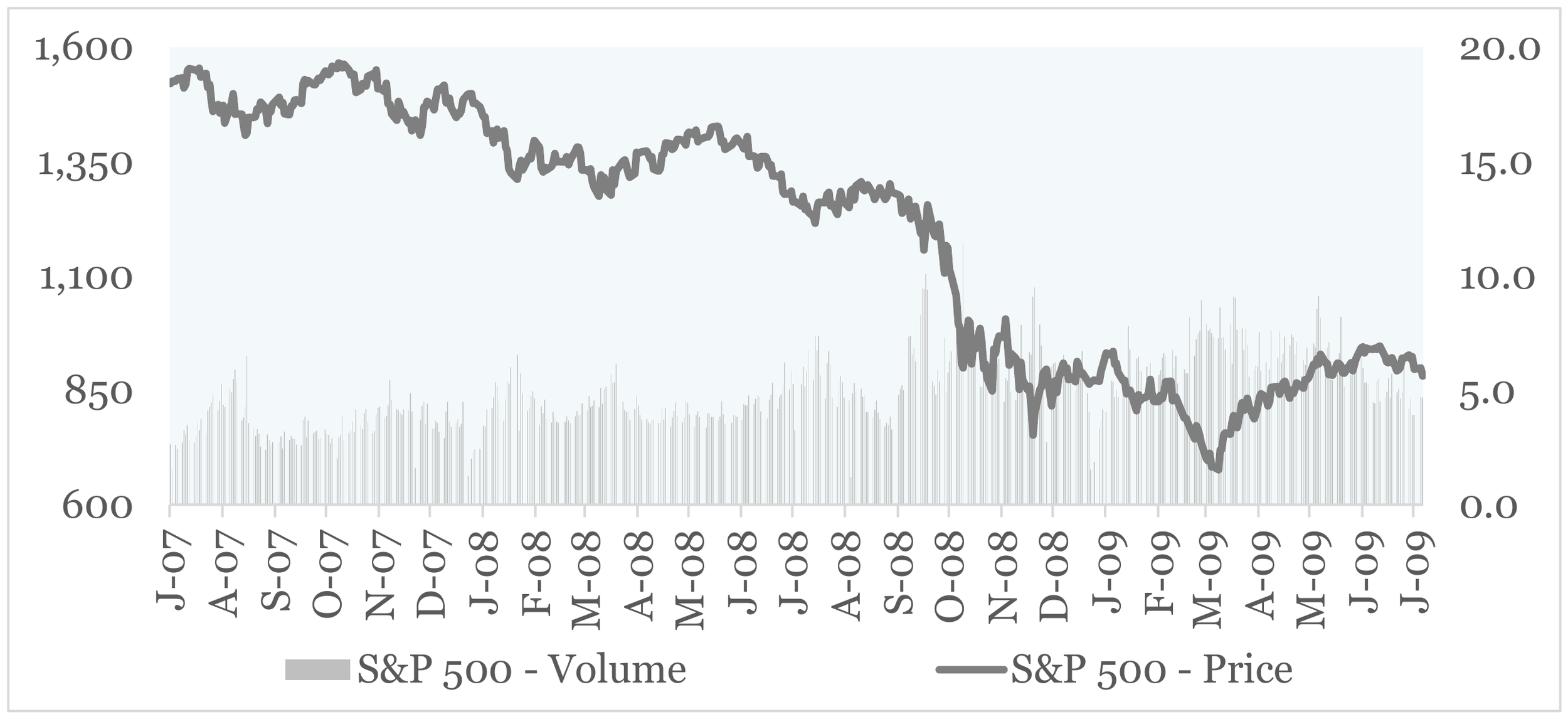
Source: Standard & Poor’s.
While the speculative fervor was centered in the fixed income market, U.S. stock prices underwent a stunning decline that neatly tracked a change of control with established financial institutions that required wholesale liquidation. Peaking at 1,565 in October 2007, the S&P 500 fell as much as 18.6% (to 1,273) in the 5 months to March 2008, when Bear Stearns emerged as the first casualty of the conflagration.[12] After rebounding 12% over 2 months to 1,427 in May 2008, when the index stood just 8.9% below the prior top, the S&P 500 renewed its descent, declining 14.8% (to 1,215) in the 2 months to July 15, when the closure of IndyMac on July 11 accentuated the bottom.[13] Rising 7.4% (to 1,305) in the month to August 11, the index contracted by a modest 4.8% (to 1,242) in the period to September 5.
What followed beggars belief, as the collapse of Fannie Mae and Freddie Mac on September 7 gave way in the following week to the forced sale of Merrill Lynch to Bank of America, the bankruptcy of Lehman Brothers, and the bailout of AIG.[14] Wachovia then failed on September 29, when the FDIC brokered the sale of its banking operations to Citigroup, an arrangement displaced by Wells Fargo’s unassisted offer for the whole company on October 3.[15] In conjunction, the S&P 500 dropped 34.3% (to 816) in the 3 months to December 1. Subsequent to the government lifeline to the automotive industry, the index leaped 14.5% (to 935) in the following month, before plunging 27.6% in the 2 months to March 9, when, at 677, it reflected a 56.8% contraction over 17 months.
Figure 4. S&P 500 Index vs. P/E Multiple
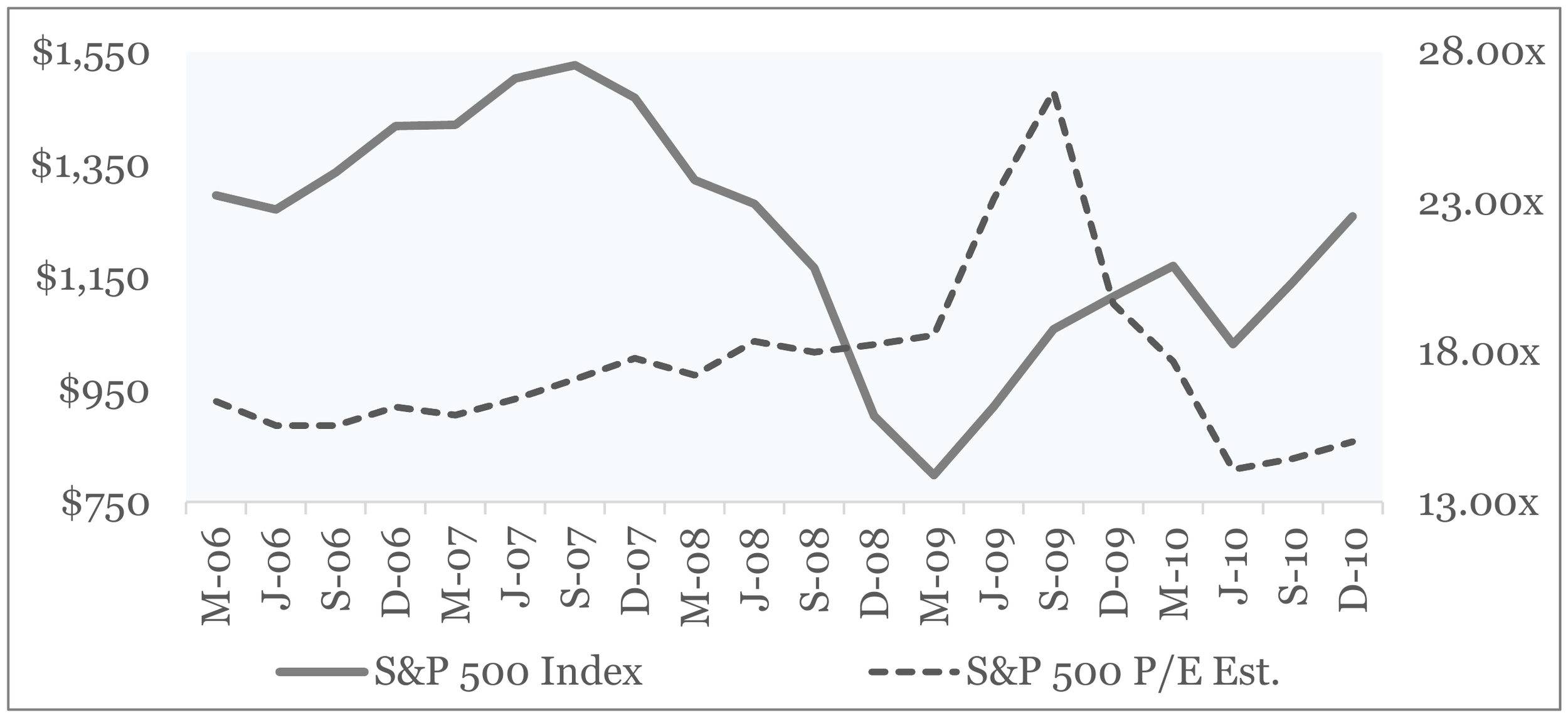
Source: Standard & Poor’s.
While unusual in the prior century, the contagion that emerged in 2008 is reminiscent of events in 1825, 1837, 1857, and 1873, when stock prices were undermined by the issuance of new securities outside the asset class. In each case, we find newly issued fixed income securities of rapidly diminished value prompting bank failures that spur liquidation and undue price drops in stocks that are not only the most junior security in the capital structure but also the most marketable. With the S&P 500 having traded (see Figure 4) at 19.4x reported EPS in September 2007, the episode is a reminder that P/E multiples lack forward guidance and that the most devastating tragedies are those stemming from a lack of imagination.[16] Perhaps most of all, the Great Recession demonstrates what can go horribly wrong with innovation in the new issues market.
Charles Lister Smith
September 17, 2026
[1] Ben S. Bernanke, “The Global Saving Glut and the U.S. Current Account Deficit,” Sandridge Lecture, Virginia Association of Economics, Richmond, March 10, 2005; Bernanke, “Rebalancing the Global Recovery,” Sixth ECB Central Banking Conference, Frankfurt, November 19, 2010.
[2] Board of Governors of the Federal Reserve System, “Discount Rate Changes: Historical Dates of Changes and Rates,” FRED series DISCOUNT; Federal Reserve Board press release, November 6, 2002.
[3] Hélène Rey, comment on Olivier Blanchard, Francesco Giavazzi, and Filipa Sa, “International Investors, the U.S. Current Account, and the Dollar,” Brookings Papers on Economic Activity 2005, no. 1: 60–61.
[4] Federal Reserve Bank of St. Louis.
[5] Filipa Sá and Tomasz Wieladek, “Capital Inflows and the U.S. Housing Boom,” Journal of Money, Credit and Banking 47, Supplement 1 (March–April 2015), 222, 247.
[6] Anil Shivdasani and Yihui Wang, “Did Structured Credit Fuel the LBO Boom?” Journal of Finance 66, no. 4 (August 2011), 1291.
[7] Shivdasani and Wang, “Did Structured Credit Fuel the LBO Boom,” 1291; James Mackintosh, “‘Cov-lite’ Loans Seen as Mark of Maturity,” Financial Times, June 4, 2007, 1.
[8] Kate Kelly and Serena Ng, “Bear Stearns Fund Hurt by Subprime Loans,” Wall Street Journal, June 12, 2007, C5.
[9] “Credit Crunch Time,” Wall Street Journal, June 28, 2007, A12; “Dimon Says Buyout Bridges Look Shaky,” New York Times, July 18, 2007, https://archive.nytimes.com/dealbook.nytimes.com/2007/07/18/for-dimon-buyout-bridges-start-looking-shaky.
[10] Saskia Scholtes, “Bear Stearns Shock Waves Gain New Force,” Financial Times, July 18, 2007; Victoria Ivashina and David Scharfstein, “Bank Lending During the Financial Crisis of 2008,” Journal of Financial Economics 97, no. 3 (2010), 325.
[11] Gary Gorton and Andrew Metrick, “Securitized Banking and the Run on Repo,” Journal of Financial Economics 104, no. 3 (2012): 427.
[12] Walter Hamilton and Tom Petruno, “Wall Street Giant Gets Fed Bailout; Bear Stearns, Squeezed by the Sub-Prime Crisis, Needs An Emergency Loan,” Los Angeles Times, March 15, 2008, A1.
[13] Joanna Chung and Saskia Scholtes, “IndyMac is Latest Credit Turmoil Casualty,” Financial Times, July 11, 2008.
[14] Andrew Ross Sorkin, “Lehman Files for Bankruptcy; Merrill is Sold,” New York Times, September 15, 2008, A1; Nanette Byrnes, “Where AIG Went Wrong,” Businessweek, September 18, 2008.
[15] Eric Dash, “Weekend Legal Frenzy Between Citigroup and Wells Fargo for Wachovia,” New York Times, October 6, 2008, B1.
[16] National Commission on Terrorist Attacks Upon the United States, The 9/11 Commission Report (Washington: GPO, 2004), 339.