
The boom that culminated in the Great Crash of 1929 had its origins in a sudden change in U.S. Treasury policy in March 1927 that caused the Second Liberty Loan to be retired fifteen years before its scheduled maturity in what Undersecretary Ogden Mills described as “one of the largest operations in the field of finance ever undertaken in time of peace.”[2] Consisting of $3.1 billion and denoting 8.2% of all NYSE-listed bonds, the Second Liberty Loan was issued a decade earlier to 9.4 million subscribers in a nation of 20.0 million subscribers, rendering the offering among the most widely-held in history.[3] Together with the Third Liberty Loan, which was issued to 18.4 million and maintained a fixed maturity in September 1928, the redemption of the Second Liberty Loan was refunded with Treasury bonds at the lowest rate on record, causing a structural decline in the long-term rate and a pivot into stocks.[4] In turn, Bernheim and Schneider (1935, 735) estimate that the number of U.S. stockholders grew from approximately 5.5 million in 1927 to 10.0 million in 1930.[5]
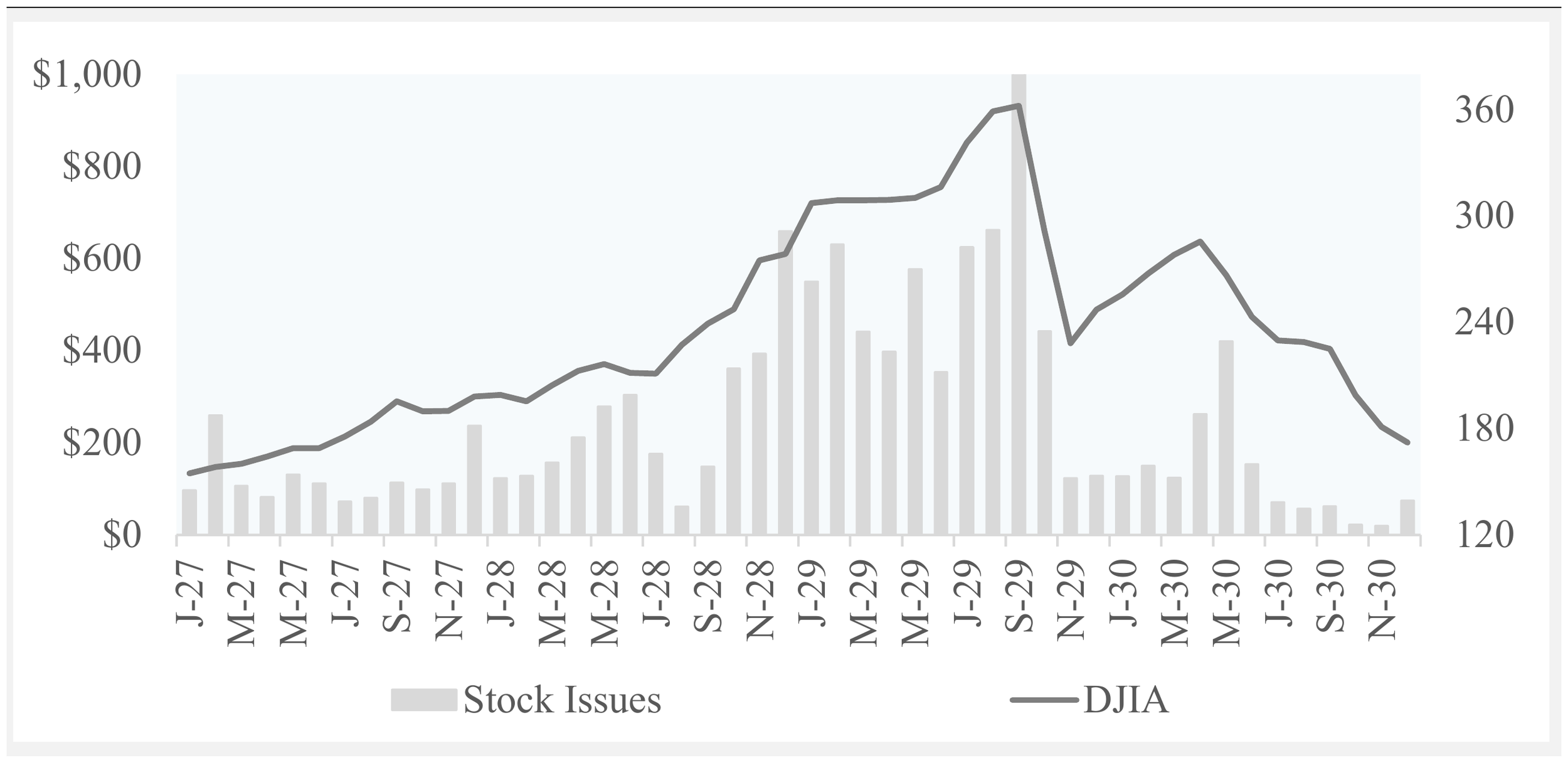
Figure 1. U.S. Stock Issues vs. Dow Jones Industrial Average
Source: Federal Reserve Bank of St. Louis.
From April 1927, when the index eclipsed the high (of 166.64) made in the prior August, the DJIA advanced by 128.7 percent (to 381.17) in the twenty-nine months to September 1929, when every major U.S. index reached its cyclical peak. In conjunction, new stock issues doubled over the previous year (from $1.5 billion) to $3.0 billion in 1928, before rising to $6.0 billion in 1929, when a stunning $1.0 billion fell in September 1929. Dovetailing with the Barings Crisis (1890), approximately 51 percent of the latter were concentrated in investment trusts and holding companies that, uniquely, used their offering proceeds to acquire other securities; a propensity that opened the door to what Adam Smith (1776) called ‘over-trading.’
With supply outpacing demand, the overhang of stocks became lodged in the inventories of underwriters, including investment banks and the security affiliates of commercial banks, where the securities were being carried with brokers’ loans. By order of magnitude, the American Bankers Association reckoned that half of the $1.9 billion of capital issues in the two months ending September 1929 were being carried by underwriters with brokers’ loans, which peaked at $8.5 billion on the NYSE.[6] Likened by contemporaries to the Rich Man’s Panic (1903), the undigested stocks in the marketplace were reflected in a structural decline in the call rate for brokers’ loans a fortnight before the same securities became the subject of a bear market raid at the front-end of the crash on October 23.[7]
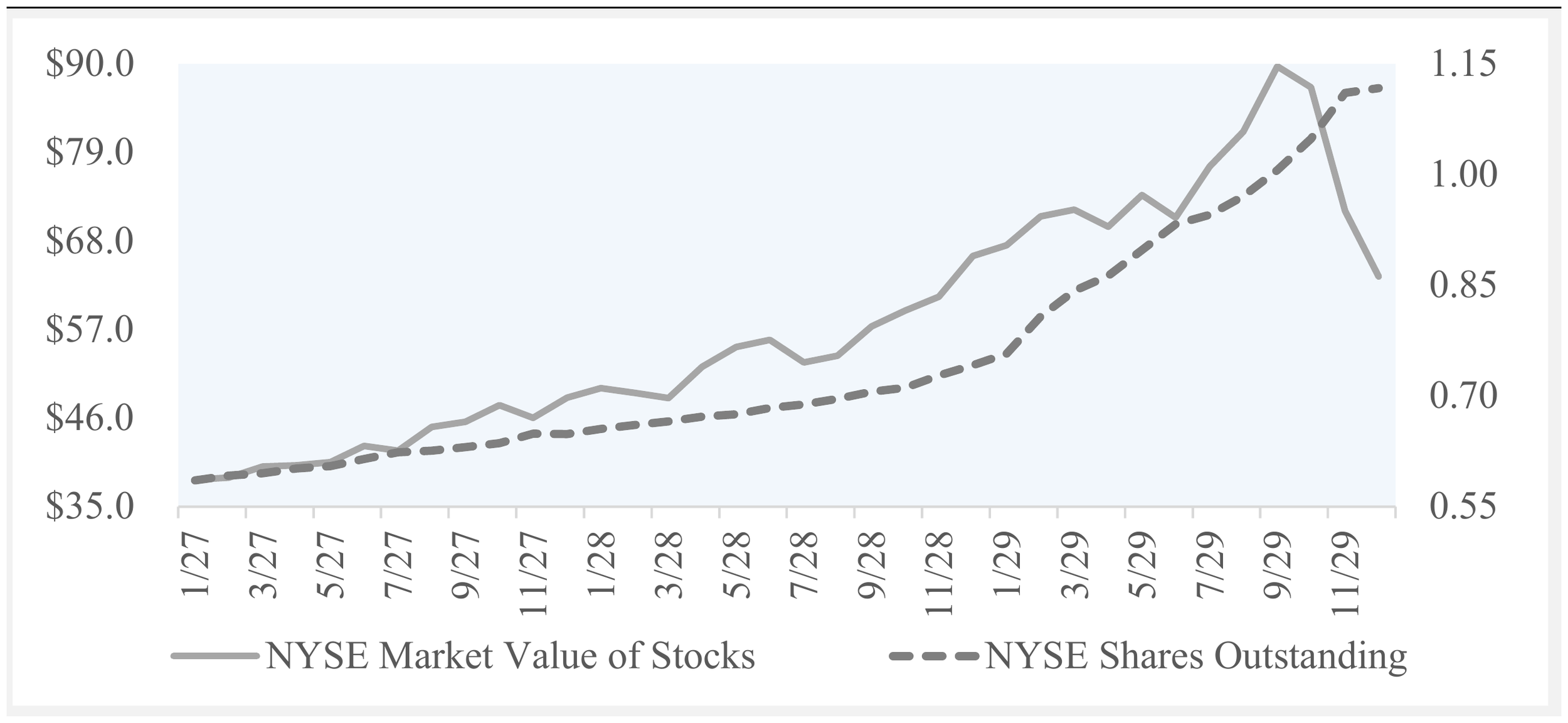
Figure 2. NYSE Market Value of Stocks vs. Shares Outstanding, 1927-29
Source: NYSE President’s Report (1930).
Stretching the fifteen trading days to November, the Great Crash unfolded in three distinct downdrafts that caused a 39.1 percent decline in the DJIA alongside a 45.8 percent fall in the Dow Jones Public Utility Index. Long associated with a withdrawal of NYSE brokers’ loans, which fell a stunning 53 percent (to $4.0 billion) in the two months beginning October 1, the lack of any spike in the call rate is indicative of a retreat among borrowers, of which a not insignificant portion can be presumed to be underwriters, who abandoned their levered positioning in the face of bear market pressures.[8] The initial downdraft, in turn, prompted two additional waves of selling that were driven by the withdrawal of credit by non-bank lenders, who, having accounted for the entire increase in lending capacity in the prior three years, acted in accordance with the profit motive and pulled funds lent in brokers’ loans, which were then governed by a structurally lower call rate that did not compensate for the augmented counterparty risk.[9]
When compared to prior episodes, the episode was made unique not only by the size of the investing community that approximated one-third of the 29.9 million U.S. households, but also by the composition of the colossal overhang, which was centered in stocks that lack the same floor value as bonds. After all, per Figure 2, the number of shares listed on the NYSE grew by 47.4 percent in the twelve months ending October 1929. This fragility was compounded by the large share of investment trusts, which effectively leveraged duplicate paper against the same underlying assets. [10] Consequently, once demand was exhausted, asset values did not merely reprice to a new yield but evaporated. Despite a material bounce in share prices, it bears mention that the price bottom formed in November 1929 was eclipsed within twelve months. Beginning in December 1930 with the collapse of the Bank of U.S., a commercial bank based in New York, material losses were revealed in the security affiliates of depository institutions, which indicates the fallout from the Great Crash contributed directly to the Great Depression.[11]
- Charles Lister Smith, PhD
June 12, 2026
[1] This memo represents the first installment in a series that reconsiders the speculative bubbles of the past 500 years using a reformulation of the Kindleberger-Minsky model developed by the author.
[2] O.L. Mills, "Speech to the Bankers Forum, New York Chapter, American Institute of Banking at the Roosevelt Hotel on December 19, 1927,” in Press Releases of U.S. Treasury, Vol. 4, 1. https://fraser.stlouisfed.org/title/6111/item/586841.
[3] Charles Lister Smith, “Easy Money? Refunding the Second Liberty Loan,” SSRN (February 23, 2026), 2. http://dx.doi.org/10.2139/ssrn.6298364.
[4] C.L. Smith, “Easy Money? Refunding the Second Liberty Loan,” 7.
[5] Charles Lister Smith, “The Great Crash Revisited: Undigested Securities and the Origins of the Panic,” SSRN (February 23, 2026), 4, 25. http://dx.doi.org/10.2139/ssrn.6298378.
[6] Separately, the NYSE President’s Report (1928, 31-32) estimates that between 10-30 percent of NYSE brokers’ loans were utilized for underwriting purposes, which indicates that up to $2.6 billion of the total was devoted to the purpose in October 1929 (“American Bankers Association,” Financial Chronicle, May 24, 1930, 3654-3655).
[7] Having pursued a rights offering that expanded its share count by one-third that expired on October 22, Bethlehem Steel Corp. was the initial target of the bear market raid (C.L. Smith, “The Great Crash Revisited,” 6, 8-10).
[8] C.L. Smith, “The Great Crash Revisited,” 8.
[9] Based on a survey of New York banks handing $2.7 billion of brokers’ loans on behalf of non-bank lenders in September 1929, approximately 58 percent of the group was composed of corporations, while 18 percent was attributable to individuals, 14 percent to investment trusts, and 10 percent to foreigners (U.S. Senate, Pursuant to S. Res 71 (1931), p. 1024).
[10] For its part, the Investment Company Index of Standard Statistics fell 52.7 percent (from 112 to 53) in the last three months of 1929 (SEC, Investment Trusts & Investment Cos., pt. 2 (Government Printing Office, 1939), 315).
[11] Charles Lister Smith, “Bank of U.S. Redux,” February 23, 2026. http://dx.doi.org/10.2139/ssrn.6298359.