
Like its predecessor, the Panic of 1825 was sparked by a refinancing of the U.K. Public Debt. Engineered by Chancellor Nicholas Vansittart and consisting of the first material reduction in obligations in seven decades, the Exchequer’s program converted £142.5 million of Navy Five Per Cents into new obligations bearing 4%.[1] A second conversion followed in 1824, when Chancellor Frederick Robinson converted £70 million of Four Per Cents into Three and a Half Per Cents Reduced.[2] While generating annual interest savings of £1.1 million, the reduction in the long-term rate dictated by the scheme – in the mind of J. Horsley Palmer, later Governor of the Bank of England, among others – was also responsible for conjuring a search for yield that spawned an unbridled wave of cross-border investment.[3] Indeed, so visible was the channel that Edward Ellice, a member of Parliament and a director of the Hudson’s Bay Company, objected to the bill’s proposal on the floor, saying holders of the Navy Five Percents were already rotating their capital into foreign funds that had advanced upwards of 8% in 10 days.[4] Facilitating these operations, the Government not only pressured the Bank of England to lower its discount rate (from 5.00%) to 4.00% and extend the currency of eligible bills from 65 to 95 days, but also extended for another decade a privilege due to expire that allowed country banks to issue notes of less than £5, permitting an outsized increase in the note circulation.[5]
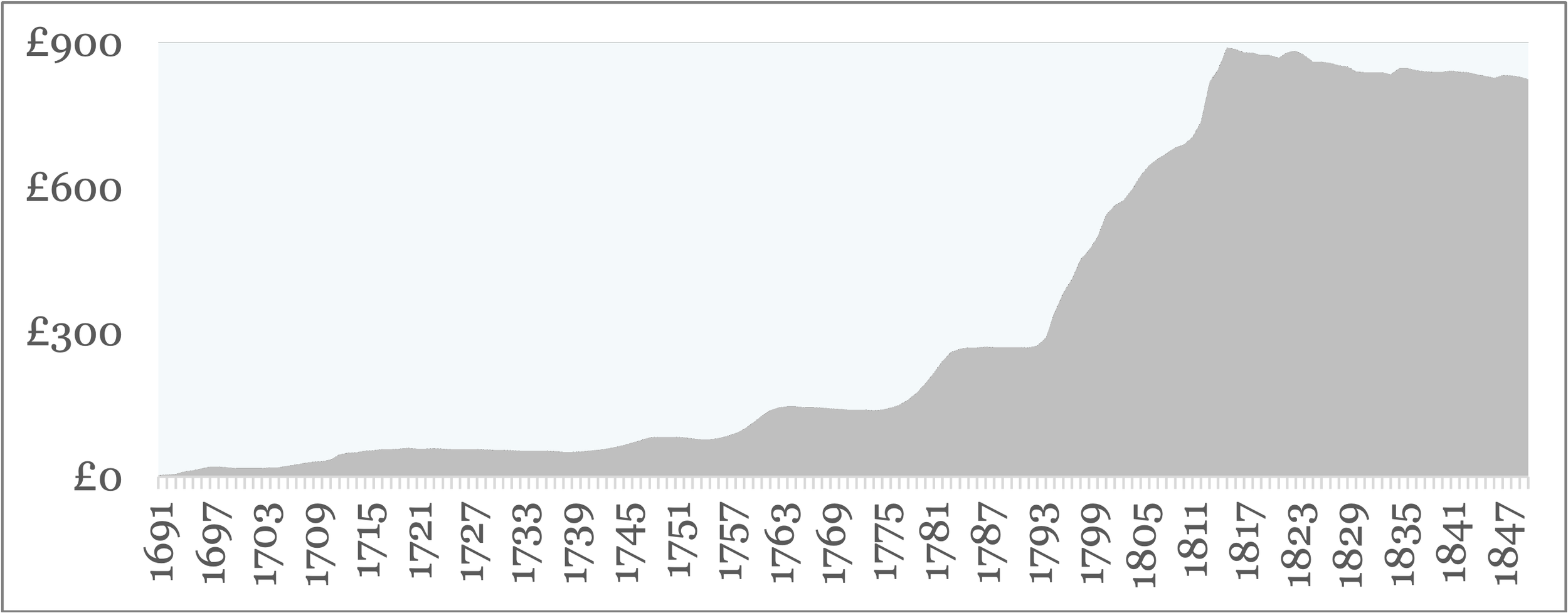
Figure 1. U.K. Public Debt, 1691–1850
Source: Federal Reserve Bank of St. Louis.
Having tripled in size on account of the Napoleonic Wars, when it rose (see Figure 1) from £288 million in 1794 to £889 million in 1815, the U.K. Public Debt turned from a drain of funds to a source of capital, falling 2.6% in the 2 years ending 1825. What was released was then promptly steered into a wave of new security offerings unobserved in a century. Against a universe of 156 stock companies, the ensuing boom during 1824 and 1825 featured the formation of 624 entities calling for a nominal capital of £372 million.[6] With their recent independence from Spain providing hitherto unknown access to British investors, the speculative element centered on opportunities in Latin America, including the stock of 26 miners and, separately, sovereign bonds. Twenty loans for foreign states representing some £40 million nominal were issued in London from 1822 to 1825, of which £25.3 million fell in the last 2 years.[7] Per Figure 2, the index of U.K. share prices from Gayer, Rostow & Schwartz, inclusive of miners, gained 89.9% in 1824, before surging 70.8% to a peak in January 1825, when the price reflected a 269% advance in 21 months. This rise was principally driven by miners, including shares in Real del Monte that, having been issued at £70, reached £550 in December 1824 and £1,350 in January 1825.[8] By contrast, the broader market, excluding miners, is shown declining as early as 1824.
Figure 2. U.K. Stock Prices, 1824–30
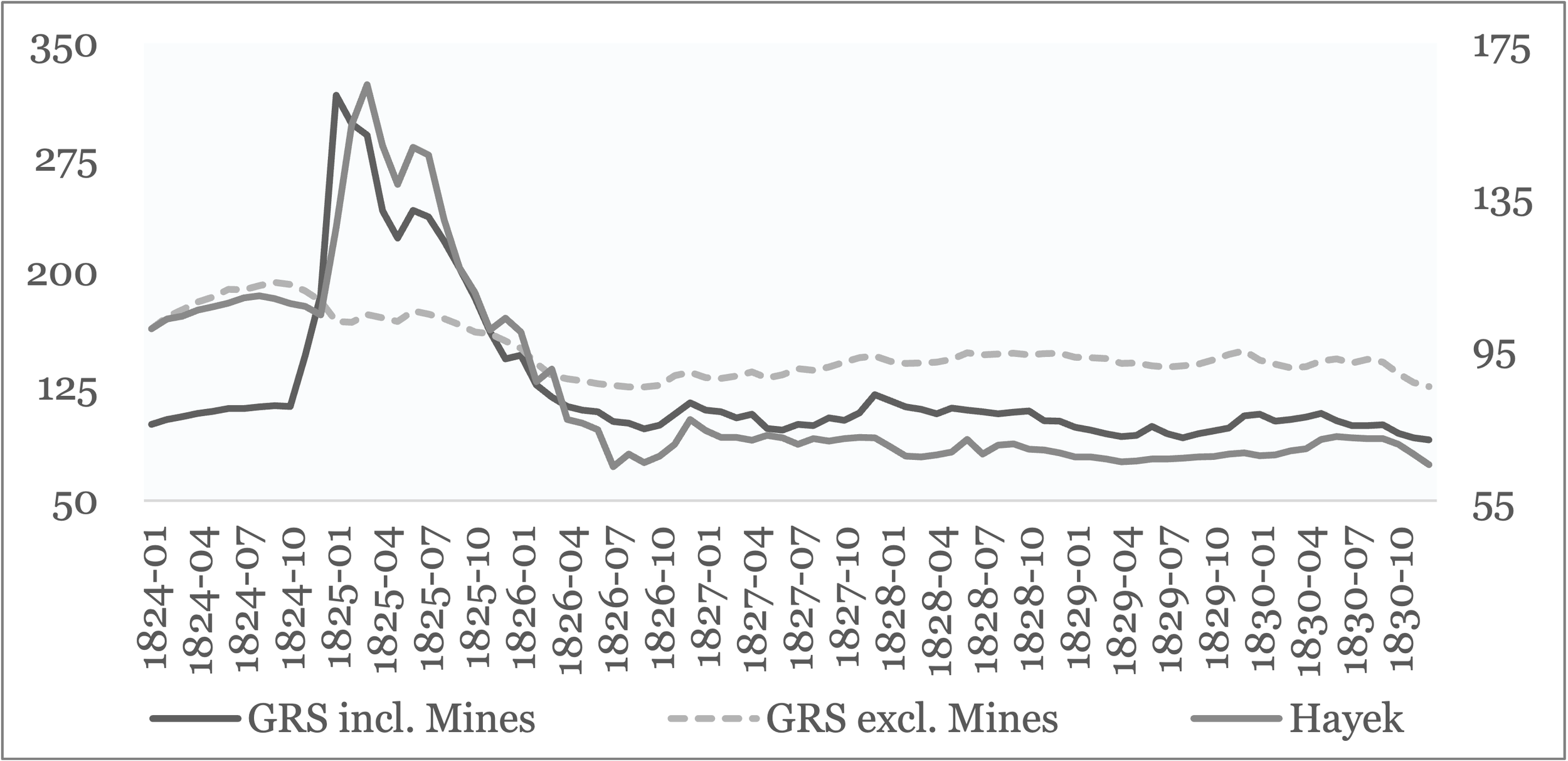
Source: Bank of England. Note that Gayer, Rostow & Schwartz excluding Mines and Hayek are positioned on the left axis; Gayer, Rostow & Schwartz including miners are shown on the right axis.
Whatever the upswell in prices, it was only a matter of time before the supply of securities eclipsed the capacity of the marketplace to absorb them. This is because stock offerings in the period were structured with installment payments that commonly included upfront amounts of less than 5% of par value. As an indication of the exhaustion of funds, had the nominal raised actually been paid in, it would have required one-third of the wealth in the U.K.[9] Naturally, when these obligations failed to clear, the subsequent price collapse revealed the saturation of British balance sheets.
After falling 29.7% in the four months through May 1825, the index of U.K. share prices notably rebounded by 8.2% in the following month, when the advance was checked in sympathy with congestion in the new issues market. In August 1825, the investment house of Barclay, Herring, & Richardson put a loan out for tender for the United Provinces of Central America only to receive a single offer.[10] Separately, in October 1825, the underwriters of a Peruvian sovereign bond issue were estimated to be holding more than 40% of the offering.[11] Paper that could not be placed, thus, remained on the books of the issuing houses, which stood at the center of the country’s banking arrangements.[12]
Beginning in December 1825, the congestion of securities turned acute with the collapse of Sir Peter Pole & Co., a leading banking house in the City that was overburdened with long-term issues and forced to suspend payment, leading to the closure of 3 other London firms and, as losses passed from agents to correspondents in the provinces, 63 country banks.[13] By February 1826, Leland Jenks records that “the bubble burst” with the closure of the investment house of B.A. Goldschmidt, which folded despite the interest installment on obligations still being in its possession.[14] Ultimately, “nine-tenths of the foreign ventures, it was soon apparent, would produce no return whatever, at any rate, for many years.”[15] Of the 26 mining companies formed to operate in Latin America, more than half had failed by 1833, and only 7 existed in 1842, while every sovereign bond issued from the region was in default by the end of 1827.[16] For its part, the U.K. stock index, inclusive of miners, declined 69.3% in the 20 months ending September 1826.
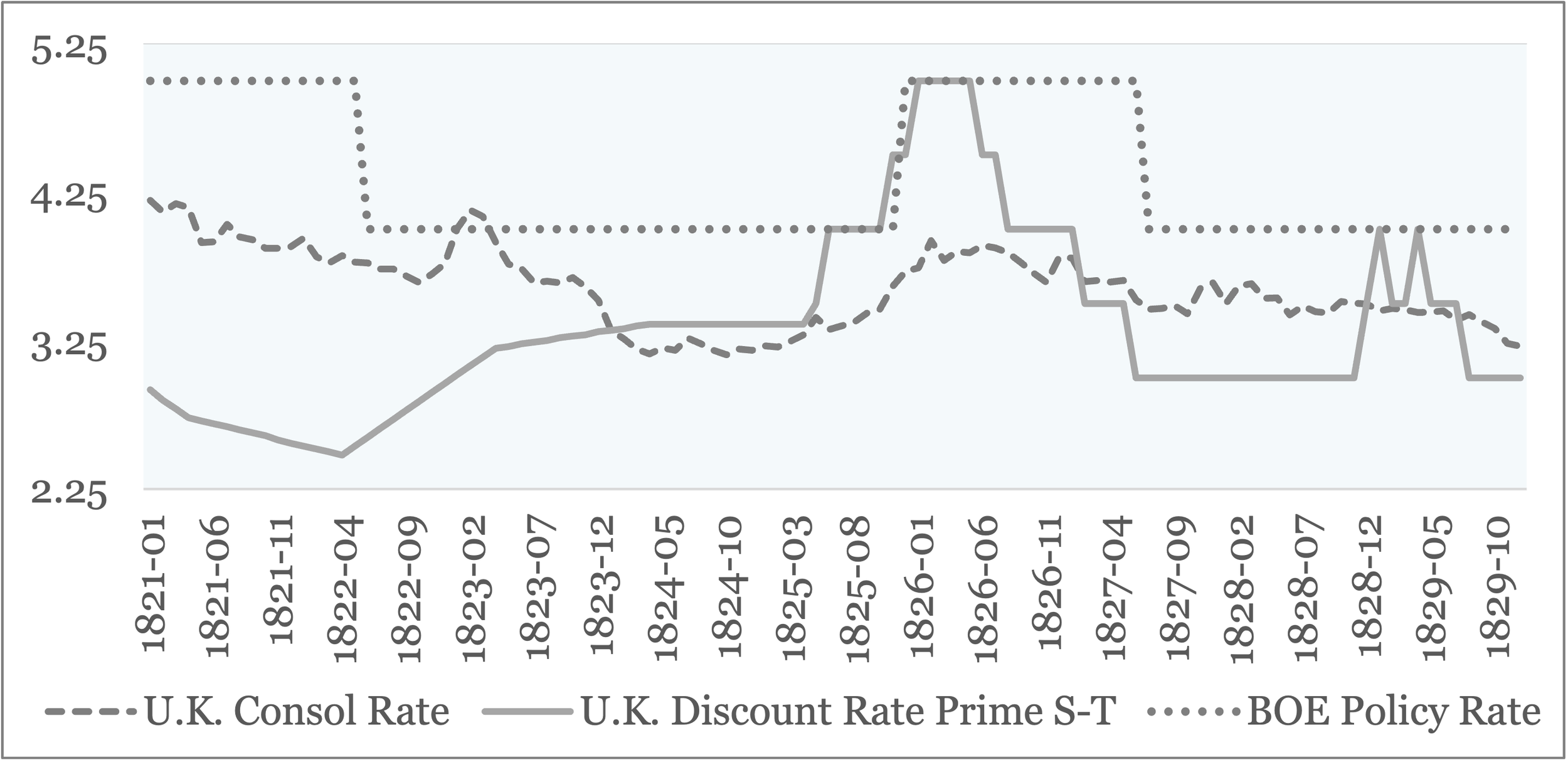
Where some have blamed the Bank of England for the Panic of 1825, it is equally true that the official policy rate was held flat (see Figure 3) until December 1825, while short-term yields had tightened by 202 bps (from 2.48% to 4.50%) in the period since April 1822. In other words, notwithstanding that the bank rate went unutilized as a policy instrument until 1847, short-term market yields advanced long before any action from the Bank of England, which maintained no mechanical link to the outsized note issues made by country banks that were responsible for the expansion.[17] When it finally moved, the Bank raised its rate to the permissible maximum of 5% at the same moment it began lending freely, so that the increase accompanied the rescue rather than any attempt to restrain, and its deterrent effect was nil against money the Committee of 1832 reckoned at 72% per annum.[18] Meanwhile, as it relates to the path of market yields, the data, unquestionably, shows the competition for capital placing upward pressure on both short- and long-term rates. That the same pattern is featured in every speculative bubble for which data is available is a further indicator that monetary policy is not only unable to dictate the path of long-term rates but also commonly overridden during speculative upswings.
Charles Lister Smith, PhD
September 3, 2026
Figure 3. U.K. Market Yields, 1821–29
Source: Federal Reserve Bank of St. Louis.
[1] UK Parliament, HC Deb 25 February 1822, vol. 6, “Navy Five Per Cents,” https://hansard.parliament.uk/Commons/1822-02-25/debates/60bde0c4-016f-442c-9b22-48636da207dd/NavyFivePerCents.
[2] W. A. S. Hewins, The National Debt: Its Origin, Growth, and the Methods Which Have Been Adopted from Time to Time for Its Reduction (1888), 254, https://www.jstor.org/stable/60214709.
[3] Charles A. Conant, A History of Modern Banks of Issue, 5th ed. (G. P. Putnam’s Sons, 1915), 619; Lawrence M. Speaker, The Investment Trust (A. W. Shaw Company, 1924), 13–14.
[4] HC Deb 25 February 1822, “Navy Five Per Cents.”
[5] W. T. C. King, History of the London Discount Market (George Routledge & Sons, 1936; Frank Cass reprint, 1972), 35; R. G. Hawtrey, A Century of Bank Rate, 2nd ed. (Frank Cass, 1962), 14.
[6] Conant, A History of Modern Banks of Issue, 620–21.
[7] King, History of the London Discount Market, 35; Rippy, “Latin America and the British Investment ‘Boom’ of the 1820s,” 122.
[8] Conant, A History of Modern Banks of Issue, 620–21.
[9] Conant, A History of Modern Banks of Issue, 620–21.
[10] Frank Griffith Dawson, The First Latin American Debt Crisis: The City of London and the 1822–25 Loan Bubble (Yale University Press, 1990), 109.
[11] Dawson, The First Latin American Debt Crisis, 111.
[12] The English system then comprised three tiers: the Bank of England, the London houses, and some 423 country banks operating 550 branches beyond the capital, each of which maintained an account with a London agent that settled its transactions and held, on average, 22% of its total assets. See Jane Olmstead-Rumsey and Giorgio Ravalli, “Country Banks and the Panic of 1825,” Explorations in Economic History 101 (2026): 101774.
[13] Conant, A History of Modern Banks of Issue, 621.
[14] Leland H. Jenks, The Migration of British Capital to 1875 (Alfred A. Knopf, 1927), 57.
[15] H.M. Hyndman, Commercial Crises of the Nineteenth Century, 2nd ed. (George Allen & Unwin, 1932), 31.
[16] Rippy, “Latin America and the British Investment ‘Boom’ of the 1820s,” 123.
[17] See Larry Neal, “The Financial Crisis of 1825 and the Restructuring of the British Financial System,” and the related commentary from Michael D. Bordo in the Federal Reserve Bank of St. Louis Review (May 1998), https://fraser.stlouisfed.org/title/820#620692.
[18] Hawtrey, A Century of Bank Rate, 14–15.