
The first great speculative tragedy to befall the U.S., the Panic of 1837, was the offspring of a boom in the transport sector that was furthered by an unprecedented sale of public lands in connection with the Indian Removal Act (1830) that sequestered large swaths of the Mississippi River Valley. Per Figure 1, having totaled $2.8 million in 1833 and $6.1 million in 1834, public land sales surged to $16.2 million in 1835 and $24.9 million in 1836. With the land quickly converted to cotton production, the proceeds engineered an extraordinary decline in the Federal Debt, which, from $49 million in 1830, was eliminated in its entirety in 1835.[1]
Figure 1. Public Land Sales in the U.S., 1830-60
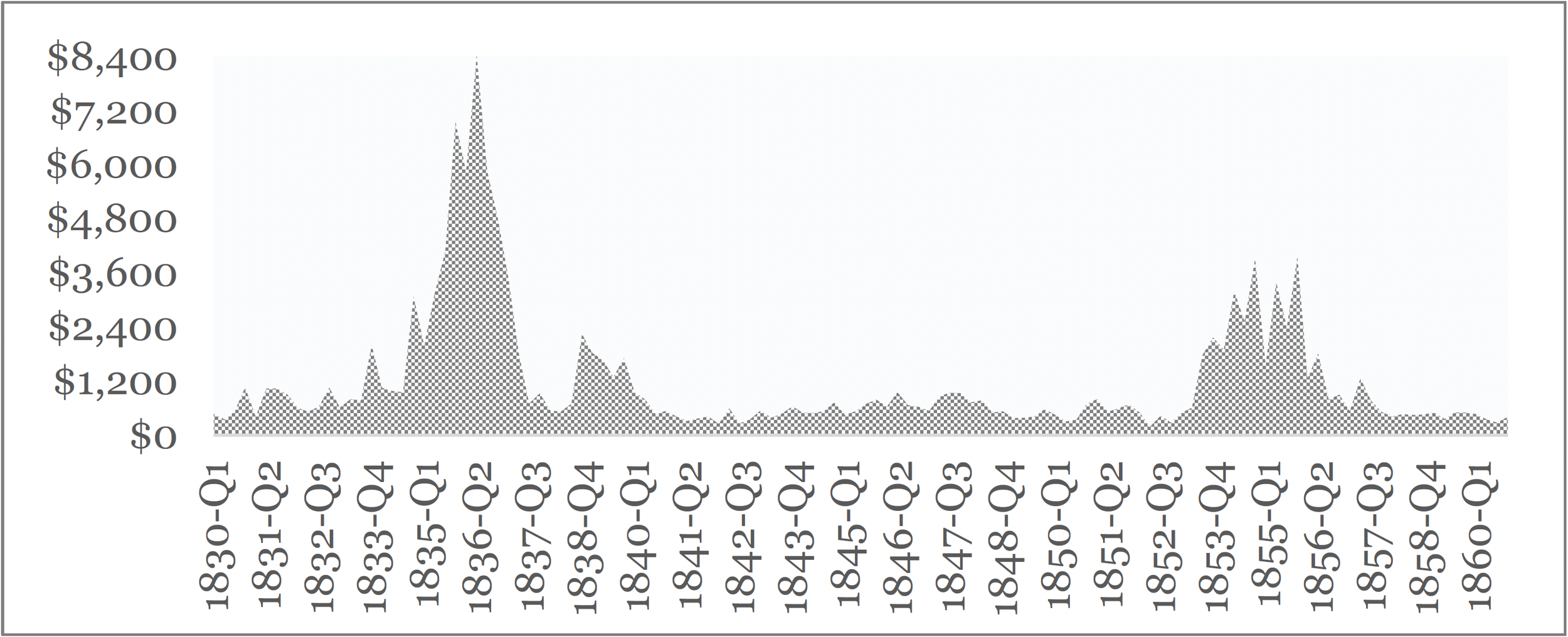
Source: Smith and Cole (1935). Receipts in thousands of U.S. dollars.
Not unimportantly, the refunded specie was deposited into commercial banks – first by holders of the Federal Debt and then by the U.S. Treasury – where the reserves contributed to a dramatic expansion in loans, which grew from $137 million in 1829 to $525 million in 1837.[2] As such, silver once destined for China had reason to accumulate in ‘wildcat’ banks, contributing to a material expansion in the money supply, which grew from $150 million in 1832 to $276 million in 1837.[3] This expansion was exacerbated by the U.S. Treasury, which changed its stance in September 1833, expressly making Government deposits available to its depository institutions for commercial purposes.[4] Spurring prices further were foreign capital flows from the U.K., where a search for yield commenced in 1834, after the Chancellor of the Exchequer, Lord Althorp, effected a conversion of perpetual annuities (from 4.00%) into lower-yielding securities bearing 3.50%.[5] In response, the excess of exports over imports of roughly $150 million between 1830 and 1837 was reinvested in the U.S.[6]
Figure 2. Stock Price Indices: Monthly, 1834-45
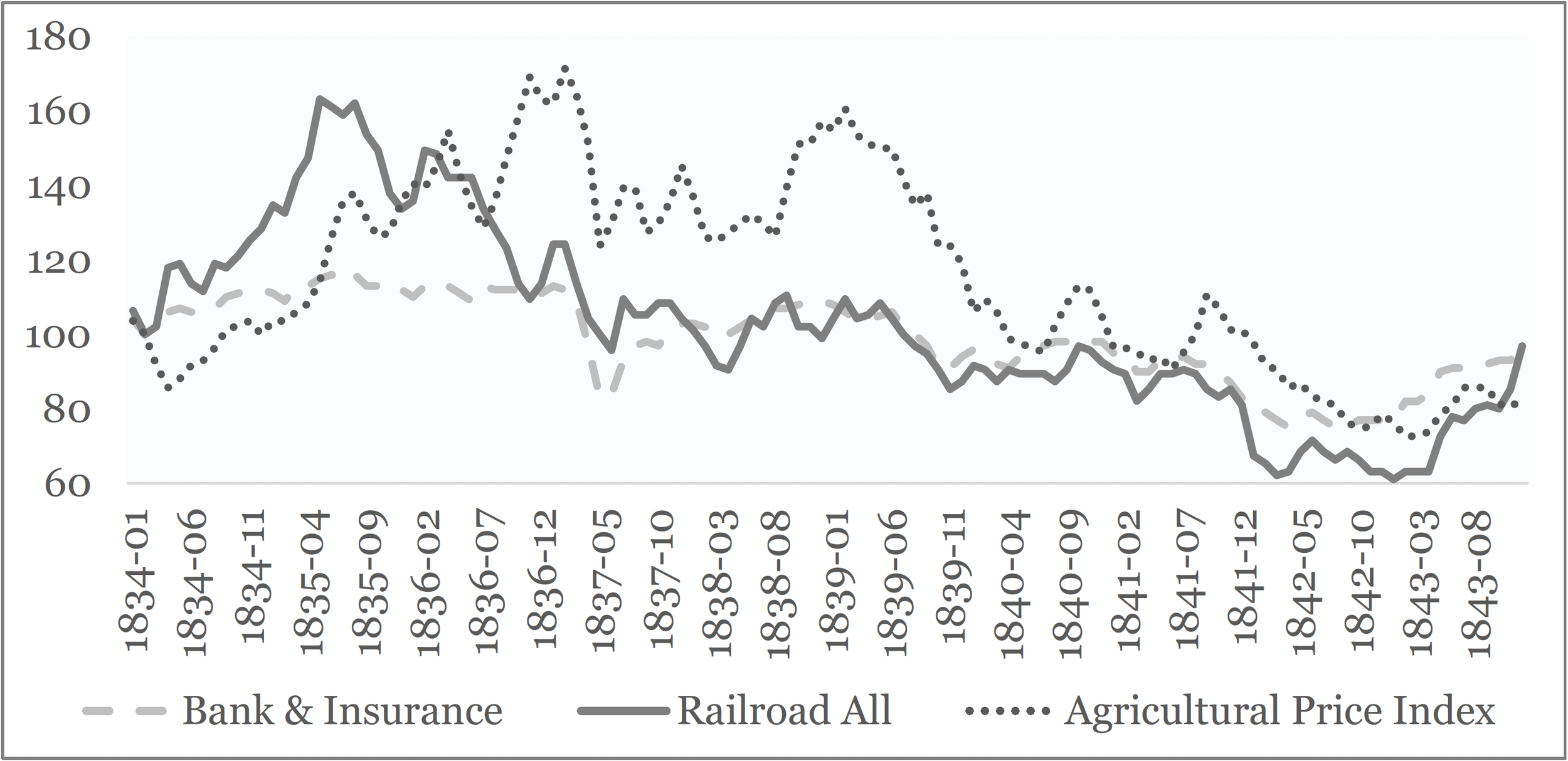
Source: Smith and Cole (1935). Index includes Baltimore & Ohio (MD), Camden & Amboy (NJ), Long Island (NY), Mohawk & Hudson (NY), New York & Harlem (NY), Paterson (NJ), Providence & Stonington (RI), Philadelphia & Reading (PA), Boston & Lowell (MA), Boston & Providence (MA), Boston & Worcester (MA), Eastern of Massachusetts (MA), Philadelphia, Wilmington & Baltimore (PA), Utica & Schenectady (NY), Western of Massachusetts (MA).
Following the success of the Erie Canal (1825), the abundant amount of capital available for reinvestment was funneled into the transport sector, including waterborne enterprises like the Ohio and Erie Canal (1832) and those in rail, such as the Baltimore & Ohio (1830) and Mohawk & Hudson (1831). In tandem, the speculative class was centered on the shares of U.S. rail operators, which were sold as widely as London. Per Figure 2, from the beginning of 1834, the index of 15 U.S. rail operators gained a remarkable 63% in 16 months. However, after peaking in May 1835, the U.S. rail index underwent a marked decline, falling 28.6% in the 21 months ending February 1837. In other words, the descent in stock prices was initiated nearly 2 years before the convulsion arrived in March 1837. Recognizing the pronounced uptick in land-sale proceeds, which surged 58.0% over the prior quarter to $3.1 million in the 3 months ending June 1835 and averaged $5.3 million in the 8 quarters ending March 1837, and that circumstances would have been unusual if purchases had not been partially funded with stock sales, it is not unreasonable to hold the auctioning of federal lands accountable for the crowding out of U.S. rail stocks.[7]
Furthered by a dramatic expansion in acceptances, the unfettered real estate investment manifested in soaring U.S. cotton production, which expanded by 26.5% over the prior year (from 1.1 million) to 1.4 million five-hundred-pound bales in 1837.[8] In the interim, downside pressure emerged in July 1836, when the Bank of England lifted its discount rate, luring funds back to the U.K., and, simultaneously, President Andrew Jackson issued the Specie Circular, which required that the payment for federal lands be settled using (only) gold and silver. A blunt instrument made necessary in the absence of a central bank, the latter directive reduced the supply of capital for the purchase of land, such that, by the fall of 1836, reports of “money stringency” were received in eastern circles from land speculators in Mississippi.[9]
Yet, cotton prices continued their ascent, rising 35.4% (from ¢11.3/lb.) over 3 months to peak at ¢15.3/lb. in November 1836. Softening in the ensuing month to ¢14.3/lb., the reckoning then arrived at the outset of 1837, when cotton prices plunged 36.4% in January, before dropping a further 11.0% over two months to bottom at ¢8.1/lb. in March.[10] With credit advanced at elevated levels, the contraction in cotton price thrust distress upon the banking community in New Orleans, where Hermann, Briggs, & Co. failed with liabilities of approximately $5.5 million.[11] The loss of funds promptly sent shockwaves to New York, leading to the demise of J. L. & S. Joseph & Co., an investment bank that represented the Rothschilds with holdings in the American Land Company and the New Brighton Association that was planning a housing development on Staten Island.[12]
While monetarists relate the crash to central bank action enacted 8 months prior, the near-halving in cotton prices is more aptly attributed to a stunning decline in Government deposits held by U.S. banks, which fell (see Figure 3) from $46 million in December 1836 to $13.3 million in August 1837 on account of a Congressional decision to distribute the fiscal surplus to the states.[13] Identified by contemporaries, alongside the heavy drafts for specie, as “the principal causes” of bank suspensions during May 1837, the act required that surplus funds be redistributed, broadly, from institutions in the west to the east, such that loans were not only curtailed, but also specie was lost on a regional basis, and the number of depositories dropped from 91 in the prior year to 54 in 1837.[14] Moreover, David Kinley (1911, 30) notes that the Government deposits in possession of state banks were widely lent for long-term investments, such that their withdrawal had an outsized effect on asset prices.
Figure 3. Balance of Government Deposits held by Depository Banks
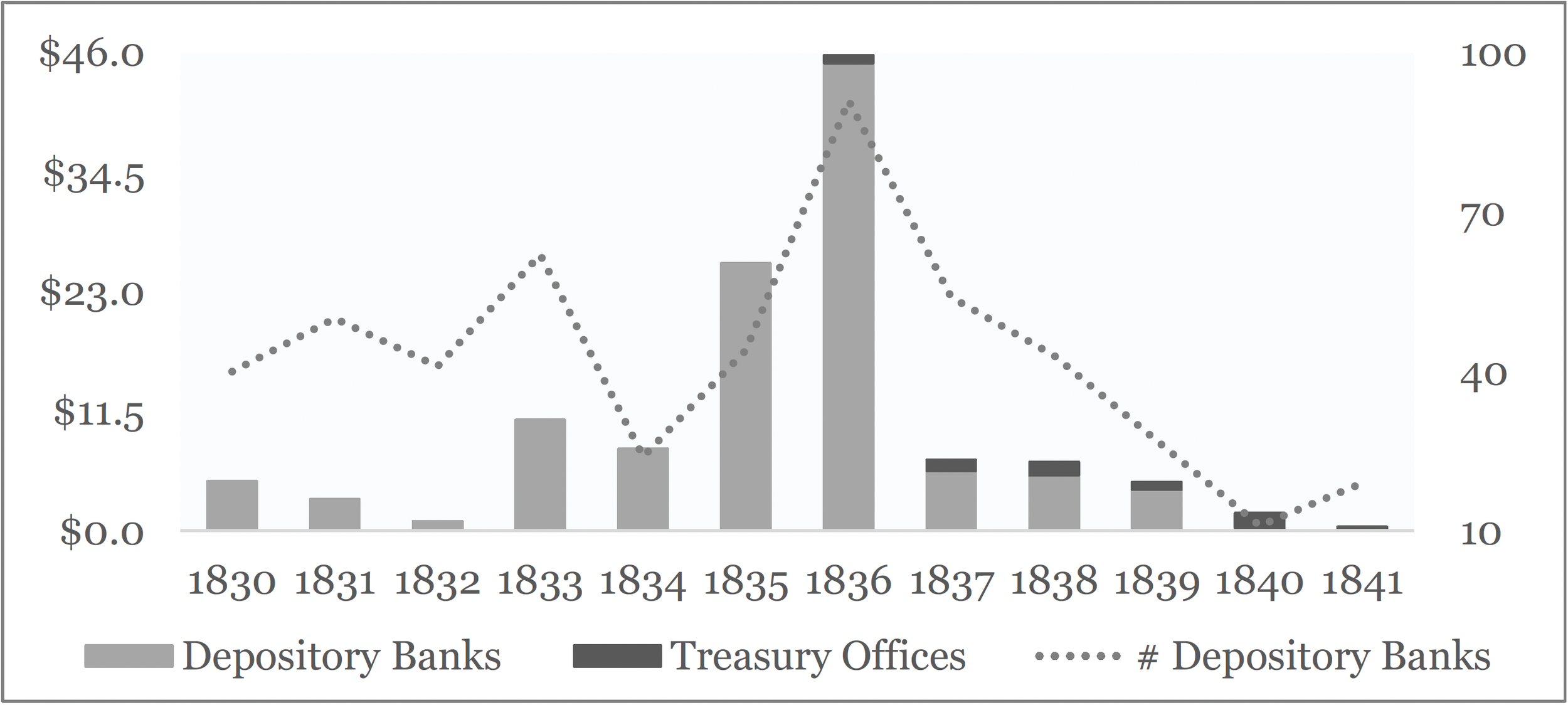
Source: Esther Rogoff Taus, Central Banking Functions of the U.S. Treasury, 1789-1941 (Columbia University Press, 1943), 268.
Yet, once the withdrawal of Government deposits had run its course and the Specie Circular was repealed in May 1838, a rare echo boom developed in the new issues market, which was inundated with bond offerings from American states that had, uniquely, emerged from the Panic of 1837 with strengthened balance sheets on account of the transfer of Government deposits.[15] From a base of $94 million in 1836, the amount of these municipal securities grew to $198 million in 1843, per Kim and Wallis (2005, 737), who estimate that half of the obligations were held by U.K. investors in 1841.
What buoyancy existed in the marketplace was upended in February 1840, when the State of Pennsylvania announced its semi-annual interest payments would be delayed.[16] Followed in March 1840 by a Congressional resolution disclaiming federal obligation for any state debts, the predictable response was a sudden shortage in foreign demand and an overhang of securities in the new issues market. In turn, in February 1841, the Bank of the United States of Pennsylvania, which had operated as the central bank of the nation before the lapsing of its charter in 1836, was found overextended with $16 million of state obligations, including those from Pennsylvania, Mississippi, Michigan, Indiana, Illinois, and Maryland, and was forced to close its doors.[17] This event ushered in a prolonged period of discredit that delivered “a mass of loss and liability” of $177 million, per Morier Evans (1859, 7), who estimates $47.3 million was related to bad loans on land purchases and $111.7 million to American State debts.[18] Meanwhile, U.S. railroad stocks traded down until March 1842, when the index indicated a 61.9% decline from its cyclical peak in May 1835.
Distinguished by the outsized role of real estate, the Panic of 1837 is made notable for the crowding out of investment in the stock market that emanated from public land sales. Marked by a gyration in Government deposits that augmented the loan base before restricting it, the episode is reminiscent of the experience in 1907, 1930–31, and 1937. It is further demonstrative of how stocks – because of their junior status in the capital structure and lower preference in litigation – suffer whenever there is a mania in the new issues market, irrespective of the asset class.
Charles Lister Smith, PhD
August 4, 2026
[1] J.J. Wallis, Table Ea650-661, in Historical Statistics of the United States, ed. Susan B. Carter et al. (Cambridge University Press, 2006).
[2] J.F. Bell, "Inflation: The Era of the State Banks," Current History, vol. 24, no. 141 (1953), 266.
[3] For money supply data, see Peter Temin, The Jacksonian Economy (W.W. Norton & Co., 1969), 71. By contrast, Temin (1969, 270) contends that silver accumulated in American banks because the Chinese abandoned their traditional desire for silver in favor of bills on London to buy opium from British India. Given that Irigoin et al. (2026, 511) date the cessation of American silver shipments to Canton to the late 1820s and recognizing that the increase in the specie stock mirrors the growth in public land sales that would have required copious sums of silver, a more plausible answer is that specie, which represented high-powered money, was allowed to accumulate in state banks that, uniquely, were relied upon to handle Government deposits in the period between 1833 and 1846 (Esther Rogoff Taus 1943, 34). What Temin treats as an exogenous shock is therefore better understood as arising from endogenous factors.
[4] As U.S. Treasury Secretary R.B. Taney told the President of the Girard Bank of Philadelphia, "the deposits of public money will enable you to afford increased facilities to commerce and to extend your accommodation to individuals" (U.S. Treasury, Annual Report (Washington, 1833) 369), https://fraser.stlouisfed.org/title/194/item/5478; Esther Rogoff Taus, Central Banking Functions of the U.S. Treasury, 1789-1941 (Columbia University Press, 1943), 35.
[5] UK Parliament, Hansard, House of Commons Debates, "Four Per Cent Annuities," 9 May 1834, cc. 802–805, https://api.parliament.uk/historic-hansard/commons/1834/may/09/four-per-cent-annuities.
[6] J.F. Bell, "Inflation: The Era of the State Banks," 266.
[7] This idea is outside the existing scholarship on the topic.
[8] Federal Reserve Bank of St. Louis, https://fred.stlouisfed.org/series/A01028USA558NNBR.
[9] Reginald C. McGrane, The Panic of 1837: Some Financial Problems of the Jacksonian Era (University of Chicago Press, 1924), 115-16.
[10] Lewis Cecil Gray, History of Agriculture in the Southern United States to 1860, vol. 2 (Carnegie Institution of Washington, 1933), 1027.
[11] Jessica M. Lepler, "The Many Panics of 1837: People, Politics, and the Creation of a Transatlantic Financial Crisis" (PhD diss., Brandeis University, 2007), 154-155.
[12] Hugh Rockoff, "Oh, How the Mighty Have Fallen: The Bank Failures and Near Failures That Started America's Greatest Financial Panics," NBER Working Paper No. 28577 (March 2021), 11-12, https://www.nber.org/papers/w28577.
[13] Structured to include $38.0 million paid out in four installments during 1837, the surplus redistribution was based on Congressional representation. However, the final payment scheduled for October 1837 was never consummated (U.S. Treasury, Annual Report for 1838, 181), https://fraser.stlouisfed.org/title/194#5483.
[14] Carl Schurz, Henry Clay, vol. 2, American Statesmen (Boston: Houghton, Mifflin, 1899), 128.
[15] Of the $174 million of American State debts in 1838, Ratchford (1941,79,88) shows approximately 35% of total proceeds being devoted to canals, while 31% is attributed to banking activities, and 25% to rail.
[16] R.M. Boeckel, “Defaulted Foreign Bonds,” Editorial Research Reports (1932), http://library.cqpress.com/cqresearcher/cqresrre1932020300.
[17] U.S. Senate Committee on Banking and Currency, "Part 7, Appendix," Pursuant to S. Res. 71, in Operation of the National and Federal Reserve Banking Systems: Hearings Before a Subcommittee of the Committee on Banking and Currency (1931), 1052, https://fraser.stlouisfed.org/title/675#22460.
[18] Separately, Ratchford (1941, 79,88) notes $108 million of obligations from nine states, or 62% of the $174 million total in 1838, was in default in 1842.