
A formative event that led to the creation of the Federal Reserve System, the Panic of 1907 arrived at the end of a decade-long boom that was bisected by The Rich Man’s Panic of 1903. The expansion was fueled by a massive step-up in worldwide gold production that reached $1.9 billion in the 5 years ending 1907, against an estimated $10.3 billion mined in the prior 500 years.[1] As an added tailwind, the Dingley Tariff Act (1897) produced large budget surpluses that were allowed to accumulate in the depositories of the U.S. Treasury, which grew from $209 million in 1898 to $422 million in 1907.[2] Using this enlarged base of Government deposits to control money rates, the U.S. Treasury increasingly abandoned its traditional role as a passive vault under Secretary Leslie M. Shaw to become an active reserve authority in this period.[3]
The augmented amount of funds made available for reinvestment manifested in rising activity in the capital markets. From its bottom (of 38.49) in April 1897, the DJIA gained 103.3% over 50 months to reach 78.26 in June 1901. Equally resurgent, new stock issues gained from $122 million in 1898 to $506 million in 1901. However, the latter declined materially to $263 million in 1902, when underwriters were caught flat-footed with outsized inventories of unsold offerings. Famously then described by J.P. Morgan as “undigested securities,” the excess inventory was estimated at a staggering $323 million in November 1902.[4] As it was recalled nearly 3 decades later, “the crisis of 1903 in the stock market was a direct result of new company promotions on a scale that had never previously been witnessed in this country.”[5]
With underwriters compelled to unload the “undistributed new securities for what they could bring,” stock prices came under downward pressure.[6] Most pronounced were declines in the industrial sector, where the over-issuance of securities had emanated. Per Figure 1, the DJIA fell 14.5% (from 78.26) to 66.89 in the 15 months to September 1902, when the DJRR, conversely, gained 10.0% (from 117.65) to 129.36. Thereafter, the sell-off widened, with the DJRR contracting 31.4% over 13 months to bottom at 88.80 in September 1903 and the DJIA descending to 42.15, where the index reflected a remarkable 46.1% fall over 29 months.
Reduced to an estimated $170 million in October 1903, the volume of undigested securities expanded by roughly $150 million in May 1904 after the dissolution of the Northern Securities Company.[7] But aided in part by the U.S. Treasury, which made $130 million available to national banks and freed up $30 million of gold by eliminating the collateral requirement on Government deposits, the overhang was reportedly de minimis by April 1905.[8] With the inventory of unsold securities seemingly cleared, new stock issues (see Figure 2) resumed their upward course, rising from $121 million in 1904 to $480 million in 1907. Equally impressive was the expansion in the number of trust companies, which grew their resources by 11.2% per annum (from $484 million to $1.4 billion) in the decade to 1906.[9] In sympathy, from the depths of the prior break, the DJIA gained 144% (from 42.15 to 103.00) in the 26 months to January 1906, before retreating, by 6.4%, in the ensuing 12 months to a lower high of 96.37 in January 1907.[10]
Figure 1. Cash from NYSE New Issues vs. U.S. Stock Price Indices
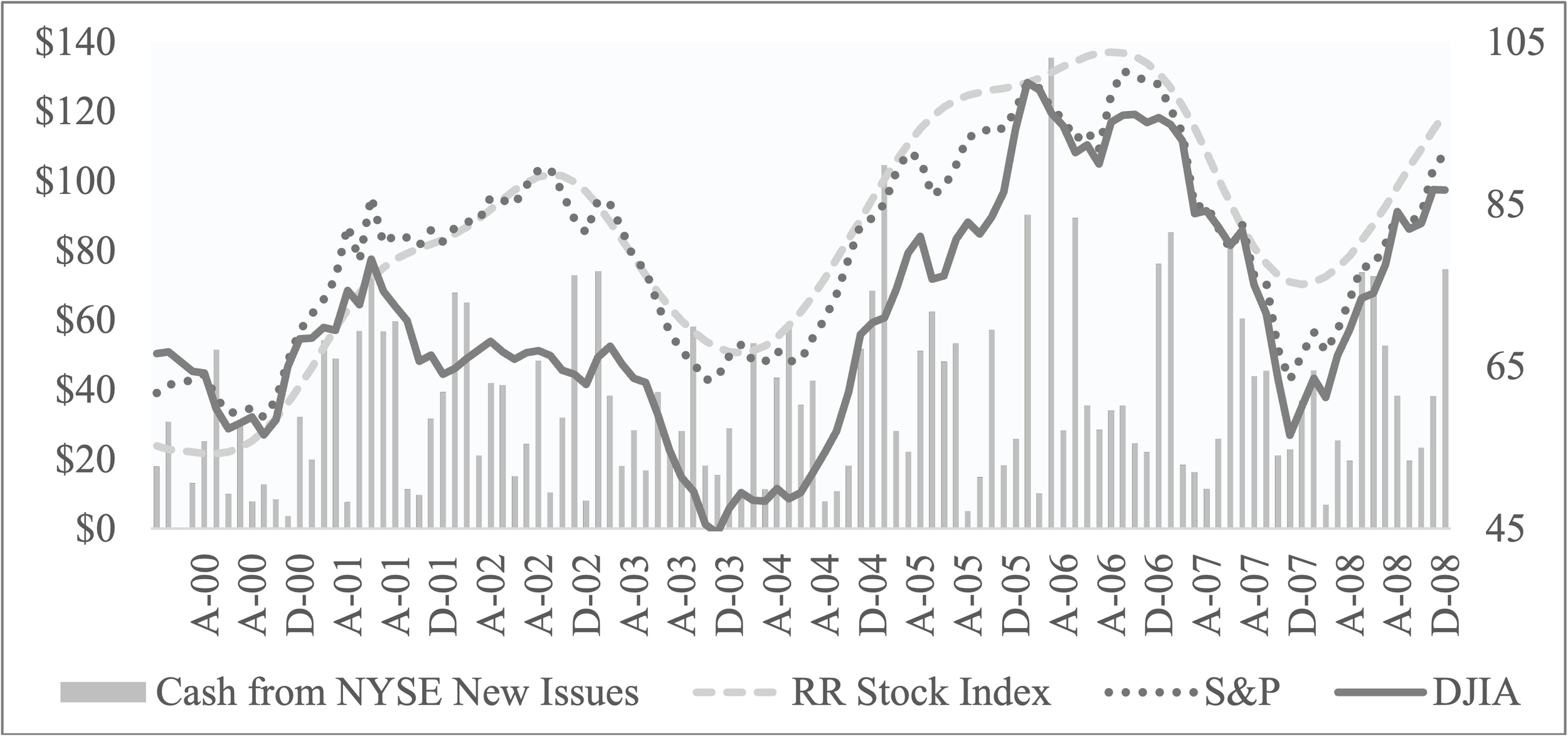
Source: Federal Reserve Banks. Figures in millions of U.S. dollars. Stock prices indexed to January 1906.
Yet, once again, the supply of new issues ran well ahead of demand in 1907, when congestion in the new issues market dovetailed with a “silent panic” that was responsible for a loss of $972 million in the 26 principal stocks on the NYSE during the initial 10 weeks of the year.[11] With one syndicate reportedly still holding 60% of an offering made months earlier, “public distrust” centered on an overhang in the shares of Union Pacific.[12] In turn, the refinancing of $115 million of Japanese bonds in March 1907 brought the “world-wide competition for capital” to the fore.[13] By August 1907, “the scarcity of capital” was reflected in the failure of municipal offerings, including the City of New York, whose $15 million offering attracted only $2.7 million.[14]
Figure 2. NYSE Stock Issues vs. U.S. Treasury Cash Balance
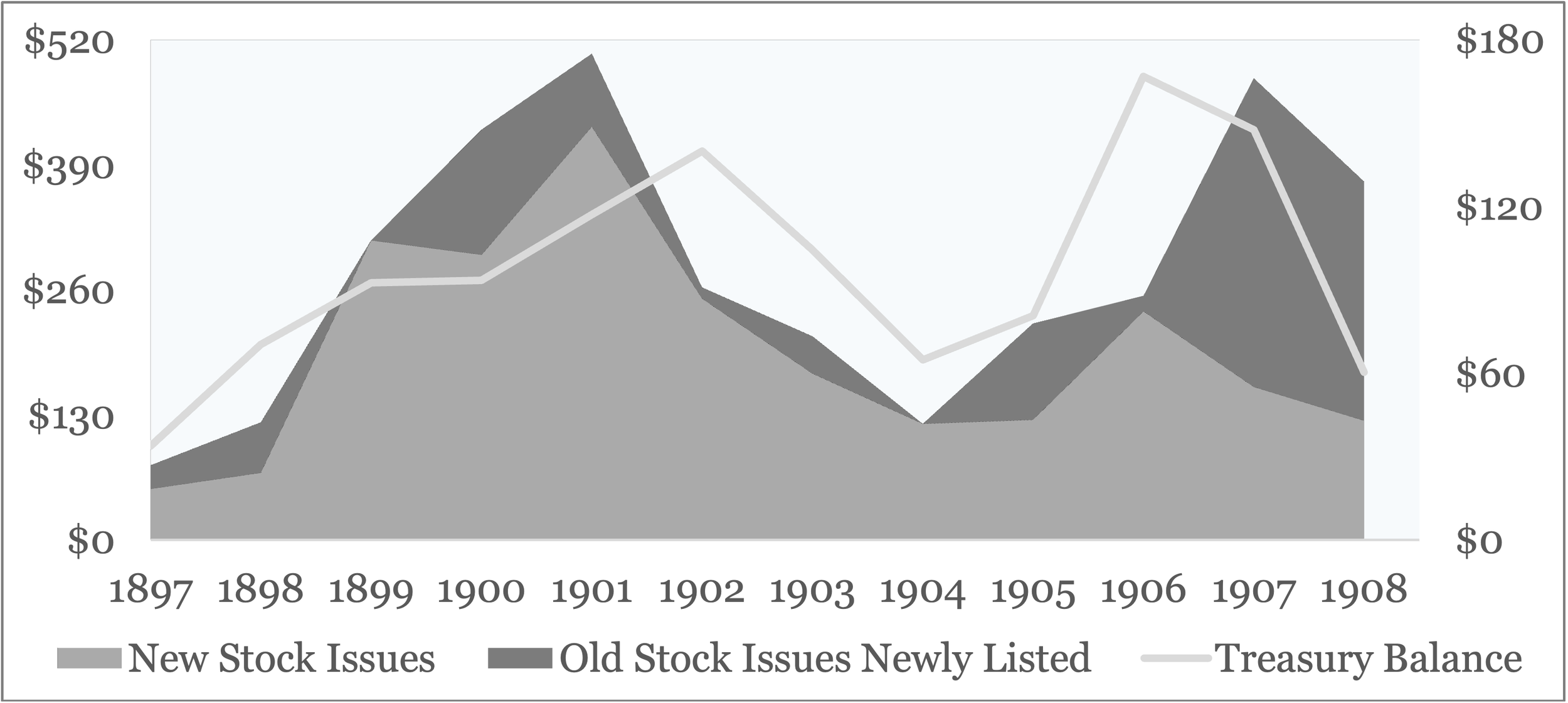
Source: “The Financial Review,” Commercial and Financial Chronicle (February 1908); David Kinley, The Independent Treasury of the U.S. and Its Relations to the Banks of the Country (U.S. Government Printing Office, 1910), 130.
Remaining elevated during the initial “new issue glut,” the price of copper (see Figure 3) followed the broader market in the back half of 1907, falling (from $0.24 to $0.16) by 33.3% in the 3 months ending September, when the markets were confronted with what was described as “one of the most absurd pieces of speculative jugglery ever attempted.”[15] Having concocted a plan to corner shares of United Copper Company, Augustus Heinze was unable to fulfill the related trades, leading to the failure of two brokerage firms and runs at several affiliate banks, including the Knickerbocker Trust Co., the third largest trust company based on its deposits of $62 million, which subsequently closed in October 1907.[16] After declining 28.1% (to 69.25) in the 8 months to August 1907, the DJIA fell a further 23.5% in the ensuing 3 months to bottom at 53.00 in November 1907, when the index indicated a 48.5% drop during the prior 22 months. Taken together, the contraction in the market value of stock exchange securities in the last 10 weeks of 1907 was estimated at $5 billion, of which $1 billion was attributed to bonds and $1.5 billion to mining and unlisted stocks.[17]
Figure 3. DJIA vs. U.S. Commodity Prices
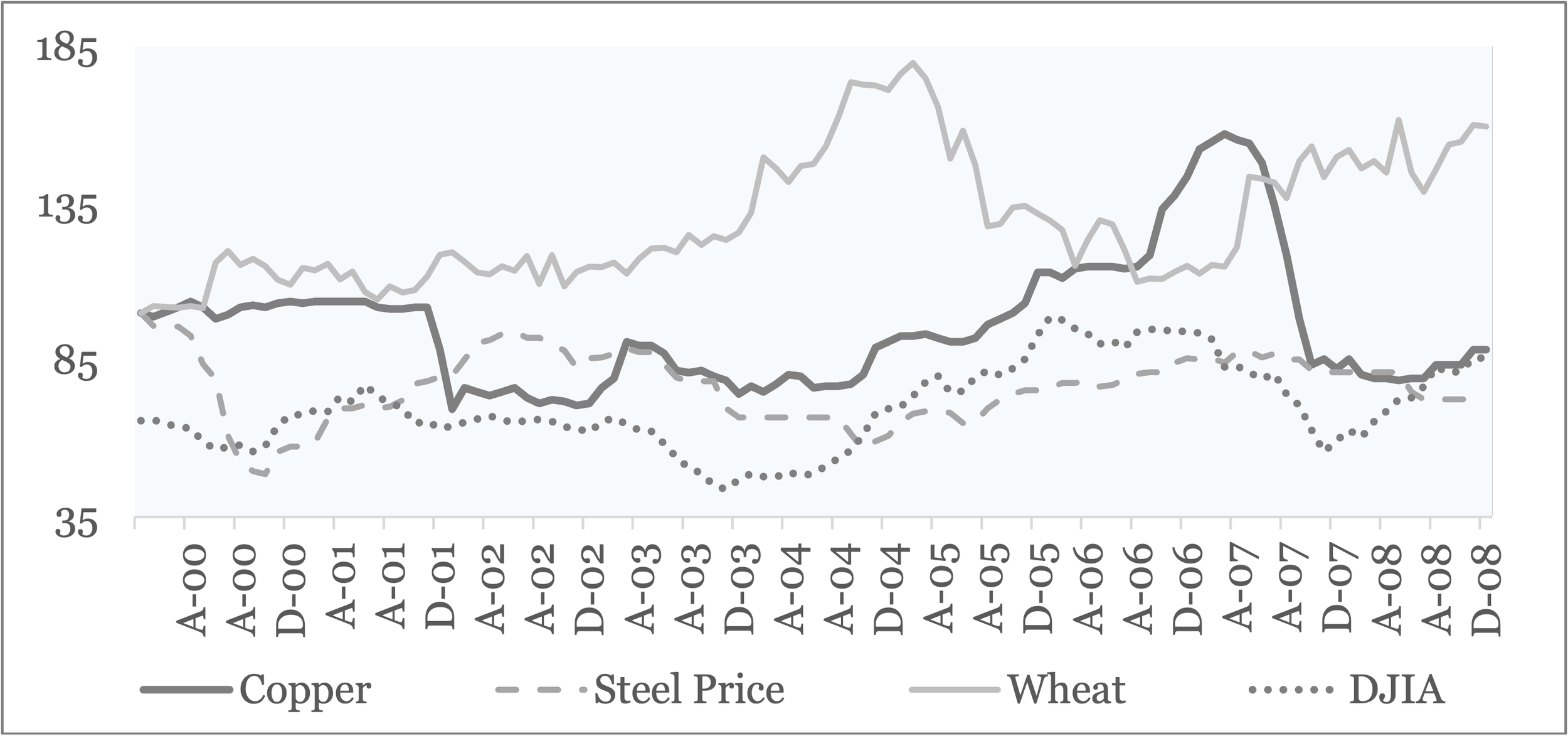
Source: Federal Reserve Bank of St. Louis.
Putting aside the $233 million of estimated excessive cash withdrawals during the last 5 months of 1907, and the restoration of order brought about by J.P. Morgan that led to calls for the formation of a central bank, it is evident that “long before 1906 had reached its end, the capacity of the American money market to absorb new stock and bond issues had approached the point of exhaustion.”[18] Echoing the sentiment, M. Leroy-Beaulieu stressed the dearth of capital in 1907, declaring: “the world has not got it; therefore, it cannot provide it.”[19] Not dissimilar, the (then) former Secretary of the U.S. Treasury, Leslie M. Shaw, attributed the crisis maelstrom to a “plethora of undigested securities” and the “extravagant living of the American people.”[20]
Where the onus rests squarely with the underwriting community, it bears to mention that the decade-long boom was not only made possible by the decline in the Federal Debt but also coincided with foreign bond offerings on a scale unobserved in a generation. In such a vein, the Rich Man’s Panic must be partly credited to U.K. Government bond offerings made in connection with the Boer War (1899-1902) that not only lured upwards of $210 million from U.S. investors during 1900-01 but also consumed foreign capital that, otherwise, might have been placed on the NYSE.[21] Additionally, one suspects the overhang would have been better absorbed by 1907, in the absence of the Russo-Japanese War (1904-05) that was led by a $1.2 billion offering by the Imperial State of Russia in 1902-03 and followed by a $425 million offering by Japan in 1906.[22]
While exacerbated by the explosive growth in trust companies and cross-border gold flows related to the San Francisco earthquake, the decline in asset prices associated with the Panic of 1907 can only be understood within the context of the overhang of securities then in the marketplace.[23] After all, no other factor explains the 46.1% decline in the DJIA following the Rich Man’s Panic of 1903, which is omitted in most narratives of 1907, when, as it happened, approximately 66.9% of the $480 million of stock offerings represented newly-listed shares of stocks offered in the prior period.[24] And if knowing the underlying drivers of the Rich Man’s Panic does not allow one to understand the 48.5% fall in the DJIA during the Panic of 1907, then what?
Charles Lister Smith, PhD
August 11, 2026
[1] Charles A. Conant, History of Modern Banks of Issue, fifth edition (G.P. Putnam’s Sons, 1915), 703; Charles A. Conant, Money and Banking (Harper & Brothers Publishers, 1905), 89.
[2] See Figure A1.
[3] A. Piatt Andrew, “The Treasury and the Banks under Secretary Shaw,” Quarterly Journal of Economics, vol. 21, no. 4 (1907), 559; Esther Rogoff Taus, Central Banking Functions of the U.S. Treasury, 1789-1941 (Columbia University Press, 1943), 269.
[4] “J.P. Morgan is Bullish,” New York Times, March 31, 1903, 1; “Undigested Securities,” Wall Street Journal, April 14, 1903, 2.
[5] “Breaks of the Past Recalled in Street,” New York Times, October 25, 1929, 3.
[6] “New Impressions of the Week: ‘Undigested Securities’ and Old-Time Reminiscence,” New York Times, October 21, 1929, 38.
[7] “Underwriters Obligations,” New York Times, October 18, 1903, F2; “The Company’s Stocks,” Wall Street Journal, March 17, 1904, 2.
[8] “Absorbing Securities,” New York Times, April 16, 1905, 15; “Mr. Shaw Releases $130,000,000 Credit,” New York Times, September 30, 1902, 1; A. Piatt Andrew, “The United States Treasury and the Money Market: The Partial Responsibility of Secretaries Gage and Shaw for the Crisis of 1907,” American Economic Association Quarterly, vol. 9, no. 1 (1908), 230.
[9] See Figure A2 in the appendix.
[10] Joseph French Johnson, “The Crisis and Panic of 1907,” Political Science Quarterly, vol. 23, no. 3 (1908), 461.
[11] “Stock Collapse Rivals Panics,” New York Times, March 15, 1907, 1-2.
[12] A. D. Noyes, “Speculation Checked by Dear Money,” The Observer, February 25, 1906, 3; A. D. Noyes, “Wall Street: New Issue Glut,” The Observer, May 26, 1907, 3.
[13] “Japan to Get $115,000,000: Conversion Loan to be Issued Soon in London and Paris,” New York Times, March 2, 1907, 4; “World-Wide Competition for Capital,” Wall Street Journal, April 24, 1907, 1.
[14] Conant, History of Modern Banks of Issue, 711-12.
[15] A. D. Noyes, “Wall Street: New Issue Glut,” The Observer, May 26, 1907, 3; “United Copper Episode,” Wall Street Journal, October 19, 1907, 2.
[16] O.M.W. Sprague, “The American Crisis of 1907,” The Economic Journal, vol. 18, no. 71 (1908), 360.
[17] Conant, History of Modern Banks of Issue, 717.
[18] A. Piatt Andrew, “Hoarding in the Panic of 1907,” Quarterly Journal of Economics, vol. 22, no. 2 (1908), 293; A.D. Noyes, “A Year After the Panic of 1907,” Quarterly Journal of Economics, vol. 23, no. 2 (1909), 200.
[19] A.D. Noyes, “A Year After the Panic of 1907,” Quarterly Journal of Economics, vol. 23, no. 2 (1909), 199.
[20] “Shaw Opposed to Central Bank Plan: Ex-Secretary of Treasury Tells National Business Club the People Do Not Want It,” New York Times, November 24, 1907, 2.
[21] Raymond Goldsmith, A Study of Saving in the United States, vol. 2 (Princeton University Press, 1955), 487.
[22] “The Financial Review,” Commercial and Financial Chronicle (February 1908), 32.
[23] W. R. Lawson, “Why Does New York Need So Much Gold? An Englishman’s Glance at Speculation Here,” Wall Street Journal, October 13, 1906, 6; Kerry A. Odell and Marc D. Weidenmier, “Real Shock, Monetary Aftershock: The 1906 San Francisco Earthquake and the Panic of 1907,” The Journal of Economic History 64, no. 4 (2004): 1002–27; Jon R. Moen and Ellis W. Tallman, “The Bank Panic of 1907: The Role of Trust Companies,” The Journal of Economic History, vol. 52, no. 3 (1992): 611-30.
[24] The narrative presented here conflicts with the monetarist reading of Milton Friedman and Anna J. Schwartz (1963, 156-68), which attributes the severity of the episode to the banking panic and the attendant contraction in the money stock rather than to any antecedent strain in the capital markets. It is, however, consistent with the accounts of contemporary observers, including Andrew (1908), Johnson (1908), and Noyes (1909), as well as Taus (1943), Richard H. Timberlake (1963), and Mary A. O’Sullivan (2016).