
While not commonly realized, the Gründerzeit, or Founders’ Boom, in Germany between 1871-73 and the Panic of 1873 in the U.S. both have their origins in the indemnity paid after the Franco-Prussian War of 1870-71.[1] Totaling Fr 5.3 billion, the French indemnity was paid in 6 installments between 1871-73, when 2 popular bond offerings were widely marketed across Europe.[2] Offered in June 1871, the initial tranche of rentes of Fr 2 billion was issued with a coupon of 5% (at a price of 82.5) to yield 6%. The second rentes were offered during 1872 and oversubscribed by more than 12 times, with more than half of the offers coming from foreign countries.[3] Increasingly, what could not be met with other savings was filled with the sale of foreign securities, including those of U.S. railroads, which went into growing default during 1873.[4]
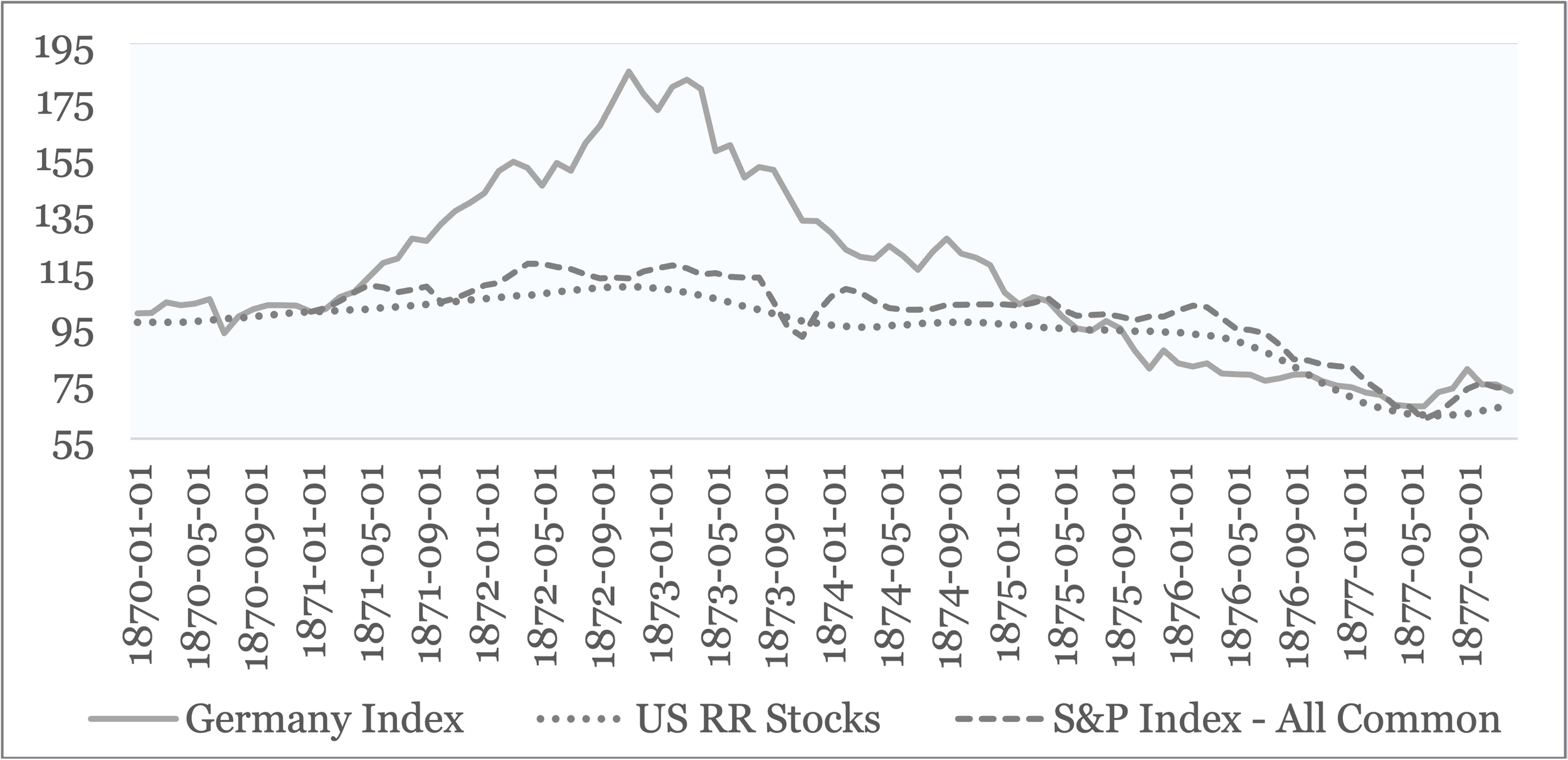
Responsible for a 40% increase in the money in circulation in Germany, the inflows from the French indemnity sparked what can rightly be called the first stock market bubble of the modern era.[5] Centered on the Berliner Börse and Wiener Börse, the infusion of funds led to the formation of 928 new joint-stock companies between 1871-73 with a nominal capital of M 2.78 billion.[6] On the Berliner Börse, listings grew from 72 in 1869 to 441 by 1873, with 168 companies brought to market in 1872 alone — the largest single year of issuance in the 7 decades that followed — of which fully half failed within 5 years.[7] In tandem, the Index of Stock Prices for Germany rose by 100.4% during the 29 months ending November 1872, when, conversely, the U.S. Railroad Index gained just 11.6%.
Falling just 3.3% in the ensuing 5 months, the German index (per Figure 1) declined 12.3% in May 1873 in sympathy with a violent crash on the Wiener Börse, where the number of listings had grown from 39 in 1867 to 378 in 1873. Inundated with new offerings, the supply of stocks overwhelmed demand, leading to paper losses of $150 million on ‘Black Friday’ alone.[8] Altogether, the value of construction-company listings on the Wiener Börse contracted by nearly three-quarters in the period to October 1873, when bank shares were broadly quoted at half their prior highs.[9] Down 28.6% in December 1873, the Index of Stock Prices for Germany marched lower until May 1877, when it stood 64.1% below the high set in November 1872, which went unsurpassed until February 1899. So damaging did the windfall prove that Chancellor Otto von Bismarck was rumored to have considered returning the French indemnity in its entirety.[10]
Figure 1. Stock Indices for Germany and the U.S., 1870-77
Source: Federal Reserve Bank of St. Louis.
Inflows received by Germany, importantly, contributed to a drain on the U.S. bond market, which had been the chief beneficiary of cross-border capital flows in the prior period. As it was, the boom in the U.S. capital markets had been furthered by the Public Credit Act (1869), which guaranteed repayment in gold in a manner akin to U.K. consols, and the subsequent Funding Act (1870) that structured a refunding of the Federal Debt. In turn, the Treasury unlocked foreign demand for U.S. Government securities with a ‘New Loan of 5%,’ offering $200 million in 1871-72. At peak, an estimated $800 million of the Federal Debt was held by foreign investors, of which some $500 million was believed to be held in Germany in early 1873.[11]
Complemented by a reduction in the Federal Debt, which fell 14.0% (from $2.5 billion) to $2.2 billion in the 3 years ending 1872, the abundant amount of capital seeking investment piled into the securities of U.S. railways. Having expanded by 1,526 miles per annum in the decade ending 1868, new rail miles averaged 5,608 per annum in the 5 years ending 1873, when the U.S. Comptroller judged the build-out had cost at least $1.7 billion.[12] By another metric, Poor’s Manual showed the total capital account of U.S. railroads roughly doubling from $2 billion in 1869 to $4 billion in 1873.[13] Of the capital deployed to construct the railroads, market observers estimated that 4/5 hailed from foreign investors.[14]
Heavily dependent on foreign capital, the equilibrium in the U.S. capital markets was promptly upturned by the outbreak of the Franco-Prussian War in July 1870.[15] “Not a drain of currency, but of capital, and especially of floating capital,” the outflows were associated with a modest pullback in security prices and the termination of several issues then underway.[16] The disruption was also believed to be temporary. Upon the settlement of the war in May 1871, the prevailing expectation on Wall Street was that German investors would unload their holdings of U.S. Government securities in favor of newly-issued bonds from American railroads that were, collectively, pursuing a vast expansion in mileage.[17] In 1873 alone, U.S. railroads planned 8,500 miles with an estimated cost of $240 million, of which $80 million was expected to originate from foreign investors.[18]
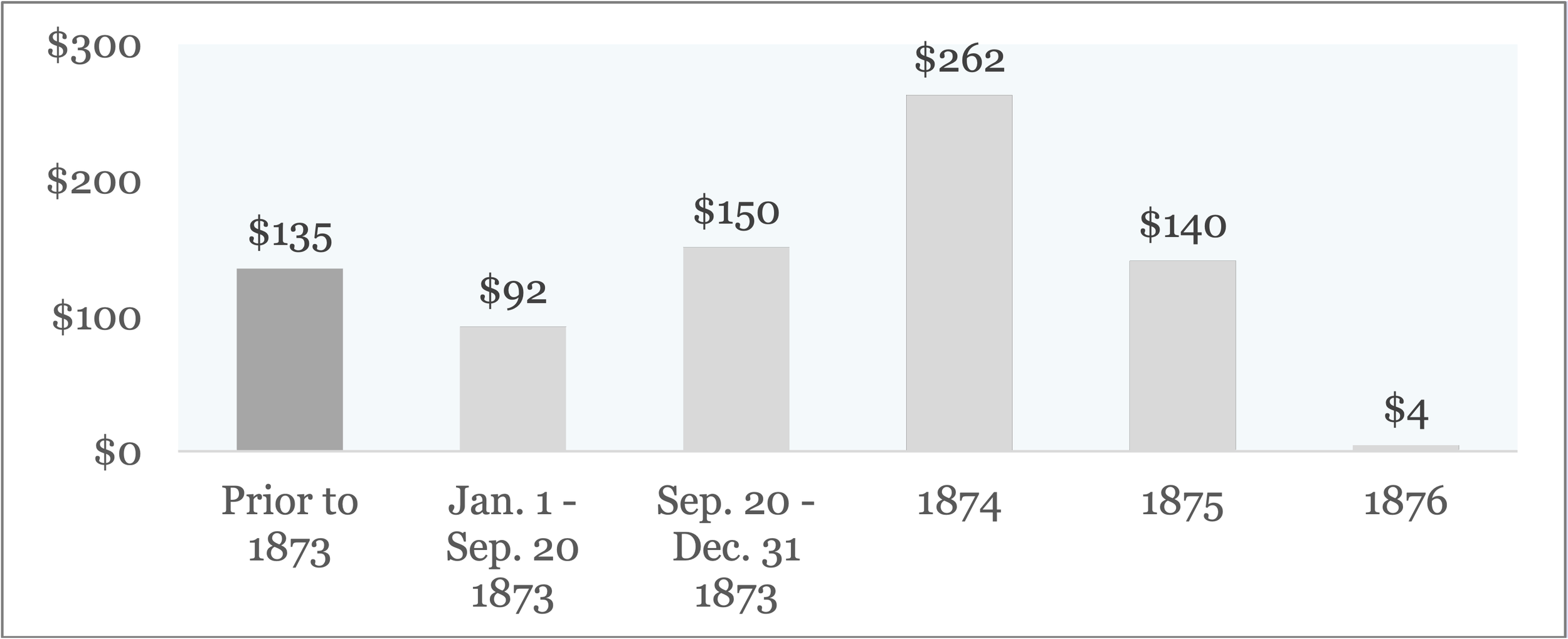
Misperceiving a profit opportunity, investment banks filled the demand gap that grew in the face of an unfettered increase in supply. However, the foreign bid for U.S. securities failed to materialize. This was for two reasons. Firstly, the wildly oversubscribed French rentes offered in 1871-72 lured investment that, otherwise, might have been committed. Moreover, the outbreak of the Franco-Prussian War had made it “impracticable to refund the national debt” as prescribed by the Funding Act (1870), such that the New Loan of 5% was largely underwritten during 1872, when the refunding competed with railroad offerings.[19] Secondly, the performance of U.S. railroad securities was increasingly poor. Already measuring $135 million in December 1872, the volume of railroad bonds in default (see Figure 2) grew a further $92 million in the first nine months of 1873. Indeed, as early as February 1873, market observers ascribed the “heavy masses of railroad paper” to a dearth of foreign investors, who had become “cautious and very discriminating” because of deteriorating fundamentals.[20] Consequently, by May 1873, market observers reckoned that German investors had largely rotated out of their vast holdings of U.S. Government securities to participate in the IPO boom on the Berliner Börse and Wiener Börse, where an estimated $1.2 billion of new issues had been brought to market.[21] “The simple fact was, there was no more loose money in Europe seeking such investments. It [had] all been absorbed.”[22]
Figure 2. New U.S. Railroad Bond Defaults
Source: Commercial & Financial Chronicle, January 22, 1876, 76.
With banks in possession of large quantities of railroad bonds no longer in demand, “the first cloud on the horizon” emerged in July 1873 with the suspension of the Brooklyn Trust Company, which had advanced a concentrated sum to the poorly-managed New Haven, Middletown & Willimantic Railroad.[23] The broader reckoning then came 3 months later, when the annual movement of crops placed its customary strain on the money market.[24] As The Economist described: “An unusually large amount of railway stock is held in New York on borrowed money, and this has made the market even more sensitive than usual.”[25] In turn, the New York Warehouse & Security Co., which had made unwise investments in the Missouri, Kansas & Texas Railroad, folded on September 8 in New York, where Kenyon, Cox & Co. was caught in the following week with an overhang of loans to the Canada Southern Railway.
More meaningfully, one-off closures succumbed to a market-wide panic on September 18 with the shuttering of Jay Cooke & Co. Against a nationwide base of deposits of approximately $4 million, Jay Cooke & Co. advanced nearly $7 million to the Northern Pacific Railroad to maintain the pace of track construction in 1873, having committed to underwriting $9 million of the rail operator’s bonds.[26] A prominent investment house and the agent of the U.S. Government, Jay Cooke & Co. also controlled the First National Bank of Washington, which entered receivership on September 19 with estimated claims of $1.7 million on $0.5 million of capital.[27] The following day, the Union Trust Co., which held a close affiliation with the Vanderbilt railroads, also suspended operations.[28]
What followed were widespread financial failings and, as was to be expected, an utter collapse in the U.S. bond market, which counted $784 million of defaulted bonds across 196 issuing railroads by the end of 1873. Of these, a remarkable $533 million remained unsettled in January 1876, when $251 million was estimated to be held abroad.[29] By modern reckoning, the defaults of 1873-75 amounted to 36% of the par value of the entire U.S. corporate bond market — a clustered default event nearly three times the worst three-year run of the Great Depression. [30] Stretching the length of 57 months from November 1872, the Index of U.S. Railroads, ultimately, fell 41.9%, while the Standard & Poor’s Index contracted by 46.9% in the 53 months from February 1873.
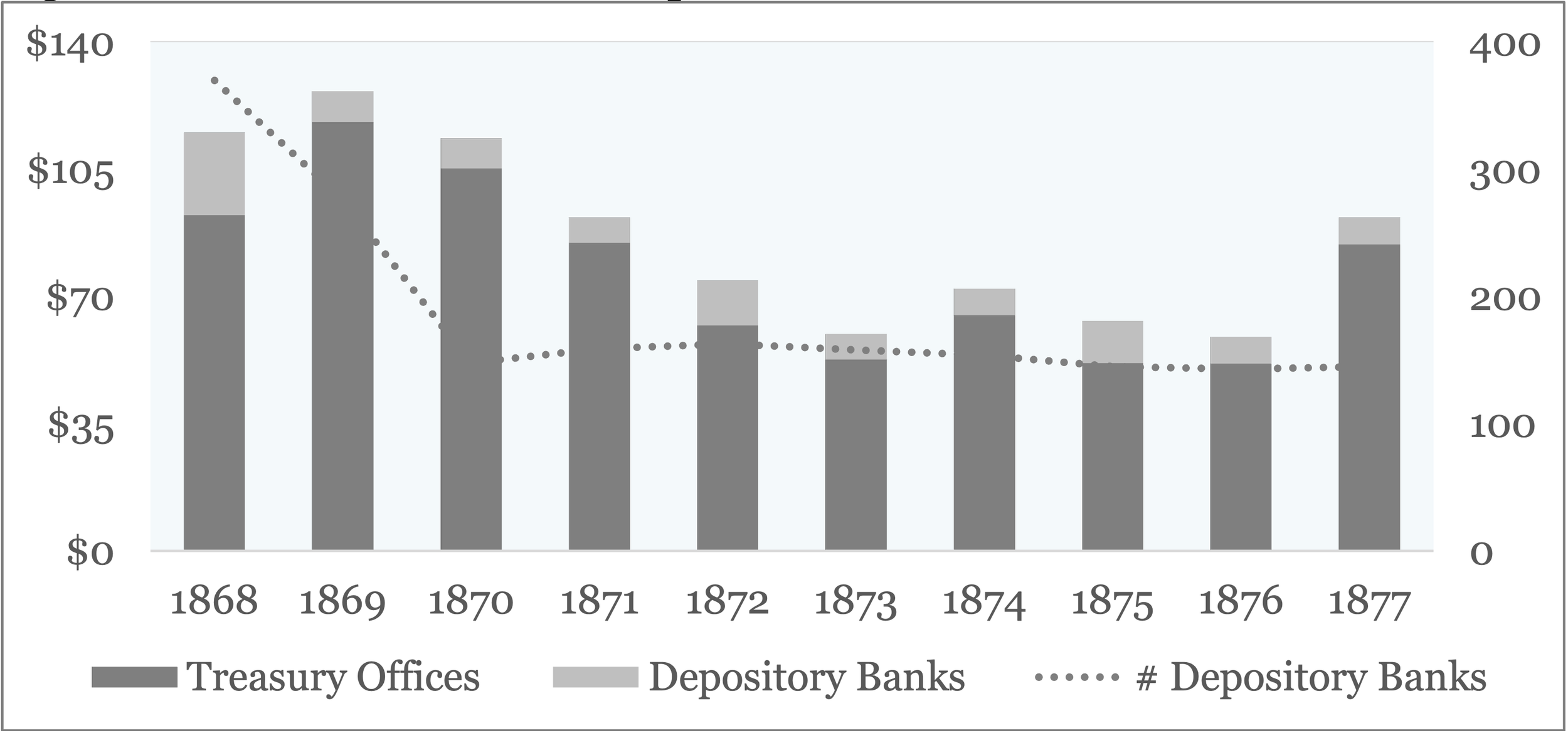
Notwithstanding the Treasury’s inability to assuage the contraction with debt purchases that likely tightened conditions for fiscal agents holding Government deposits (see Figure A2), it is evident that the Panic of 1873 was the offspring of a flood of new paper in the U.S. bond market. Put more bluntly: “The cause of the panic of 1873 was an over-issue of railroad paper.”[31] A rare point of scholarly consensus, the episode is representative of what investors can expect in a speculative bubble centered on fixed-income securities that, invariably, have been expressed in mounting delinquency rates, which presage bank failures that necessarily include asset liquidations that place outsized pressure on stock prices. By comparison, the Gründerzeit typifies the path of speculative bubbles in the stock market, where prices have routinely been broken on the back of a proliferation of IPOs that act like a liquidity shock at the end of a market cycle, when investors must sell securities to purchase anew. Together, the events signaled the end of the international bill as the primary instrument of cross-border settlement and the beginning of the age of sovereign bond issues, which defined global finance for the next 2 decades and set the stage for the Baring Crisis (1890).
Charles Lister Smith, PhD
August 18, 2026
[1] Georg Bielschowsky, “War Indemnities and Business Conditions,” Political Science Quarterly, vol. 44, no. 4 (1929): 535–536.
[2] M. Leon Say, “How France Paid the Indemnity to Germany,” Banker's Magazine, vol. IX, no. 7 (January 1875), 512.
[3] Arthur E. Monroe, “The French Indemnity of 1871 and Its Effects,” Review of Economics and Statistics, vol. 1, no. 4 (1919): 269.
[4] Say, “How France Paid the Indemnity to Germany,” 512.
[5] Monroe, “The French Indemnity of 1871 and Its Effects,” 275; F.W. Taussig, International Trade (Macmillan, 1927), 272.
[6] Among others, Deutsche Bank (1870), Commerzbank (1870), and Dresdner Bank (1872). See Monroe, “The French Indemnity of 1871 and Its Effects,” 275.
[7] Carsten Burhop, David Chambers, and Brian Cheffins, “The Rise and Fall of the German IPO Market, 1870-1938,” Jahrbuch für Wirtschaftsgeschichte 59, no. 1 (2018): 17-18, 20, 23.
[8] Liaquat Ahamed, 1873: The Rothschilds, the First Great Depression, and the Making of the Modern World (Penguin Press, 2026), 115-17.
[9] Andreas Resch and Dieter Stiefel, “Vienna: The Eventful History of a Financial Center,” in Global Austria: Austria’s Place in Europe and the World, eds. Günter Bischof, Fritz Plasser, Anton Pelinka, and Alexander Smith (University of New Orleans Press, 2011), 118, 120.
[10] See Robert V. Eagly, “Business Cycle Trends in France and Germany, 1869-79: A New Appraisal,” Weltwirtschaftliches Archiv 99 (1967): 91.
[11] The Economist, October 9, 1880, 1117; “American Railroad Bonds in Germany,” Commercial & Financial Chronicle, February 22, 1873, 241.
[12] Federal Reserve Bank of St. Louis; “The Panic of 1873,” Banker's Magazine, vol. XLVI, no. 5 (November 1891), 392.
[13] Henrietta M. Larson, Jay Cooke: Private Banker (Harvard University Press, 1936), 407.
[14] “Panic in Wall Street,” Harper’s Magazine, December 1, 1873, 127.
[15] Commercial & Financial Chronicle, July 16, 1870, 77; Commercial & Financial Chronicle, July 30, 1870, 141-42; Commercial & Financial Chronicle, August 6, 1870, 174.
[16] Commercial & Financial Chronicle, February 25, 1871, 230.
[17] Matthew Simon, Cyclical Fluctuations and the International Capital Movements of the United States 1865-1897, PhD Dissertation submitted at Columbia University (April 1955), 127.
[18] Railway Monitor, March 15, 1873, 71.
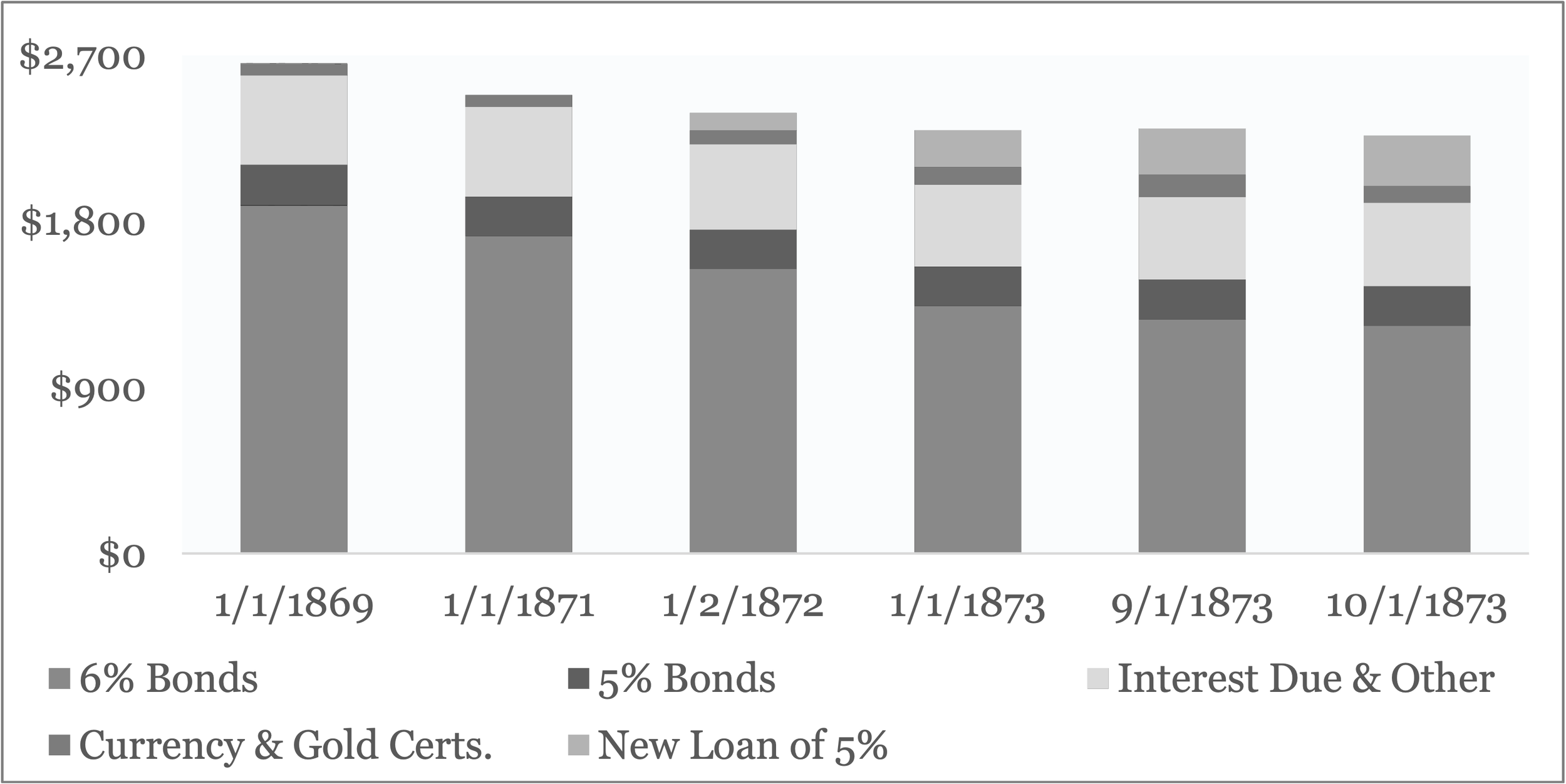
[19] U.S. Treasury, State of Finances for 1870 (Government Printing Office, 1870), vi. See Figure A1.
[20] “Financial Dangers,” Commercial & Financial Chronicle, February 1, 1873, 142.
[21] “The Vienna Panic and Its Effect Here,” Commercial & Financial Chronicle, May 17, 1873, 647.
[22] “Panic in Wall Street,” 127.
[23] “The Panic of 1873,” 396.
[24] The Economist, November 15, 1873, 1379; “The True Principles of Banking,” Banker's Magazine, vol. XXVIII, no. 5 (November 1873), 329-33.
[25] The Economist, October 4, 1873, 1202.
[26] “The Panic of 1873,” 394; Larson, Jay Cooke: Private Banker, 401, 407; M. John Lubetkin, Jay Cooke’s Gamble: The Northern Pacific Railroad, the Sioux, and the Panic of 1873 (University of Oklahoma Press, 2006), 273.
[27] “Panic in Wall Street,” 128; Commercial & Financial Chronicle, September 20, 1873, 375; Comptroller of the Currency, Annual Report for 1873, xc.
[28] “The Panic of 1873,” 393-94.
[29] Commercial & Financial Chronicle, January 22, 1876, 78-79.
[30] Kay Giesecke, Francis A. Longstaff, Stephen Schaefer, and Ilya Strebulaev, “Corporate Bond Default Risk: A 150-Year Perspective,” Journal of Financial Economics 102, no. 2 (2011): 233.
[31] “The Panic of 1873,” 396. See also Oliver M.W. Sprague, History of Crises Under the National Banking System (Government Printing Office, 1910), 1, and The Economist, October 4, 1873, 1202.
Figure A1. U.S. Federal Debt
Source: Banker's Magazine, vol. XXVIII, no. 5 (November 1873), 389.
Figure A2. U.S. Government Deposits
Source: Esther Rogoff Taus, Central Banking Functions of the U.S. Treasury 1789-1941 (Columbia University Press, 1943), 269.