
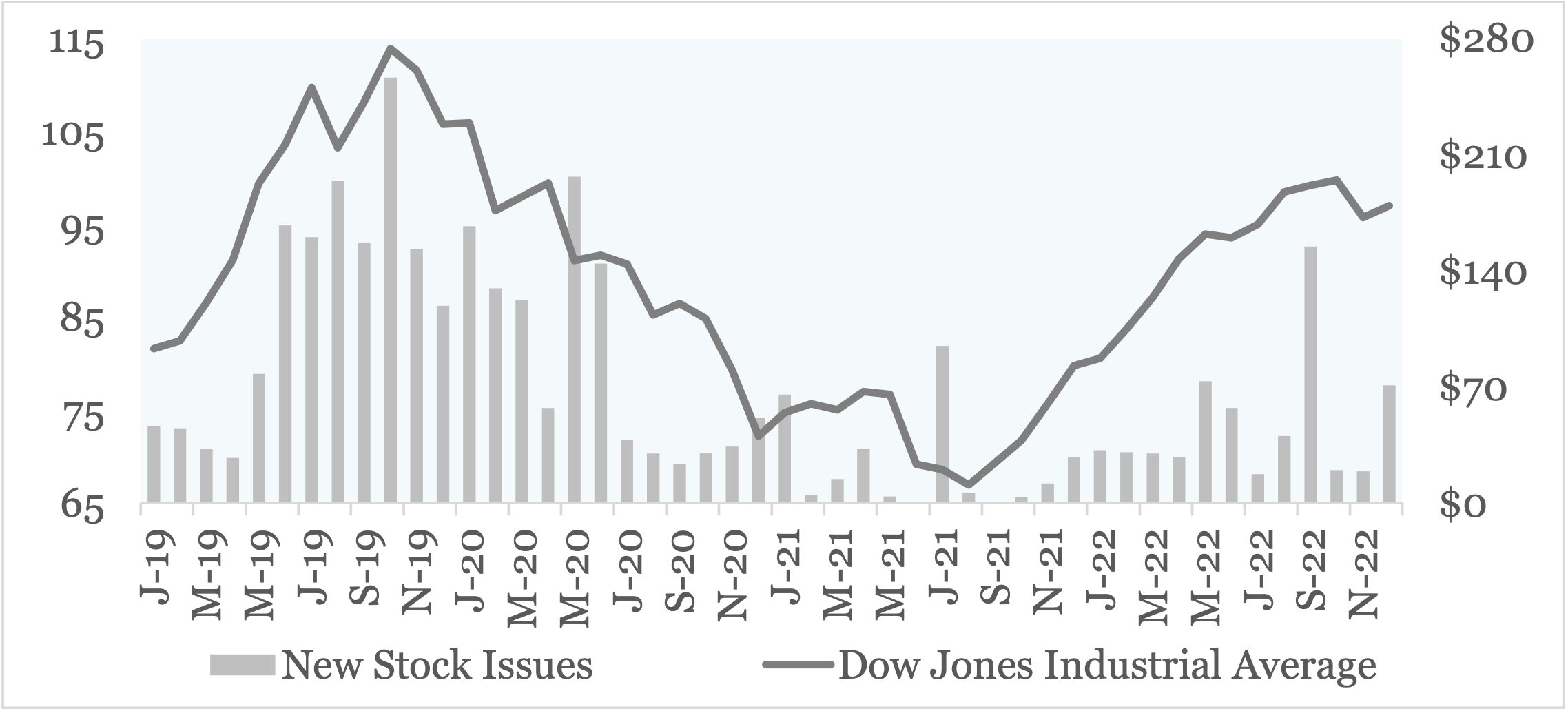
The Depression of 1920-21 was led by a resurgence in the U.S. capital markets that accompanied the conclusion of World War I in November 1918. With the Capital Issues Committee having disbanded in the ensuing month, the upswell included a proliferation of new stock issues that grew from $46 million to $257 million in the initial nine months of 1919. Per Figure 1, this activity occurred in connection with a resurgence in stock prices, including the DJIA, which gained a stunning 51.1% (from 79.15 to 119.62) in the nine months ending November 1919.
Almost immediately, the securities boom was brought into conflict with the war financing plans of the U.S. Treasury, which was compelled to return to the capital markets with the Victory Loan in April 1919. Totaling $4.5 billion, the Victory Loan was structured with a 5-year term, rendering it the first intermediate offering of the U.S. Treasury, at a taxable coupon rate of 4.75%, indicating a 50-bps tightening from the Fourth Liberty Loan issued just six months prior. It was also unplanned and financed with a scheme that called on member banks to underwrite the offering by discounting eligible securities or borrowing from the Federal Reserve Banks.[1]
Figure 1. NYSE New Stock Issues vs. Dow Jones Industrial Avg.
Source: Federal Reserve Bank of St. Louis.
Perhaps suitable for wartime, the arrangement produced not only a postwar spike in the money supply that can be credited with reviving activity in the capital markets but also the competition for capital that left member-banks holding a glut of U.S. Government securities. Absent sufficient market demand, the member banks of the Federal Reserve System were forced to fill the gap, such that by September 1919 the institutions held $1.4 billion of war paper that represented 84% of all discounted paper with the central bank.[2]
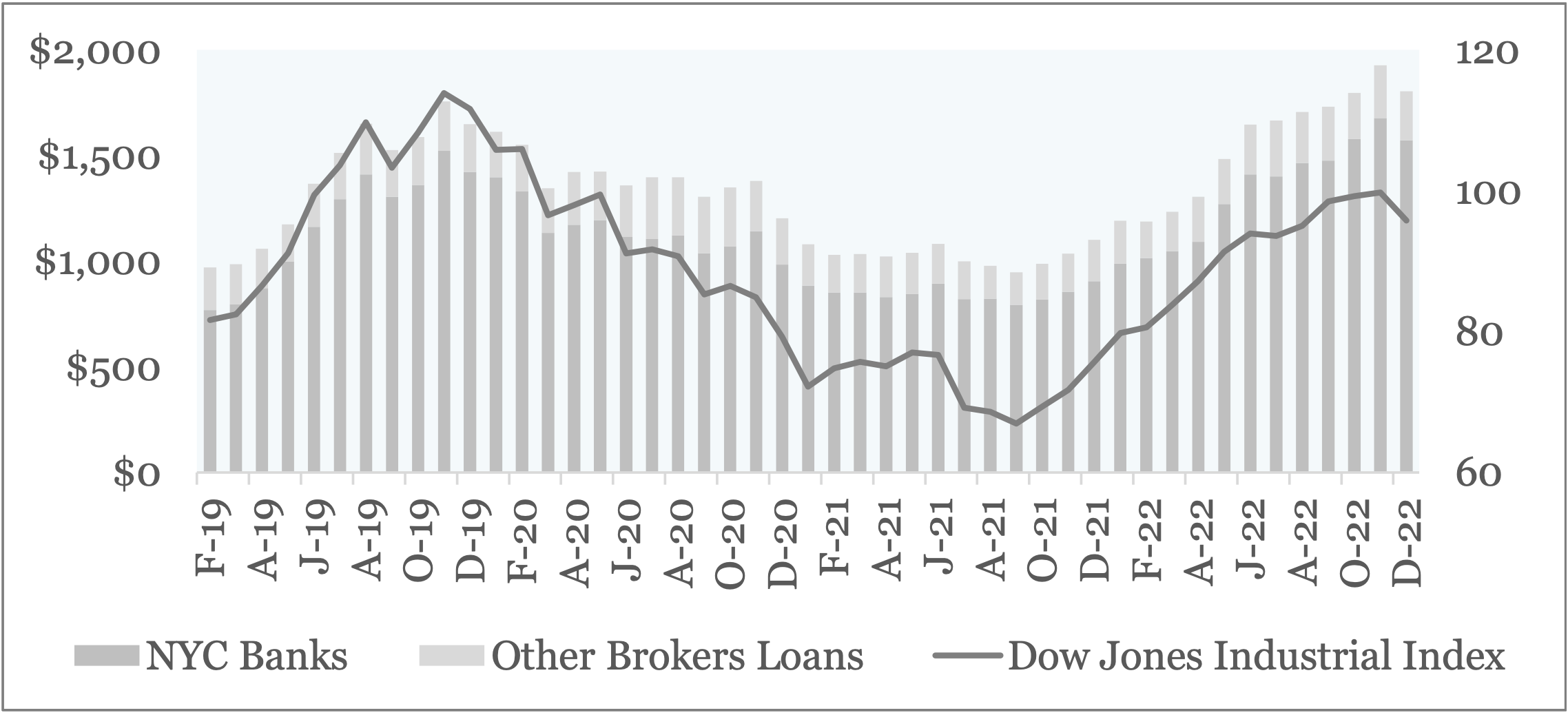
Figure 2. NYSE Brokers Loans vs. Dow Jones Industrial Avg.
Source: NYSE, President Report (1929), Federal Reserve Bank of St. Louis.
Predictably, the competition for capital reached the breaking point in November 1919, when the Federal Reserve Bank of New York lifted its discount rate (from 4.56%) to 4.74%. Long admonished for both its slow response and aggressive tightening, which saw the official rate reach 7.00% in June 1920, monetary officials were candid that the oversupply of U.S. Government securities had prevented the central bank from lifting the discount rate at an earlier date.[3] In response, member banks not only unwound their holdings of U.S. Government securities, which fell 25% (from $3.5 billion) to $2.6 billion in the period to December 1920, but also withdrew their surplus funds extended on the NYSE, where (per Figure 2) brokers’ loans attributable to New York banks plunged 47.9% (from $1.5 billion) to $0.8 billion in the twenty-two months from November 1919.
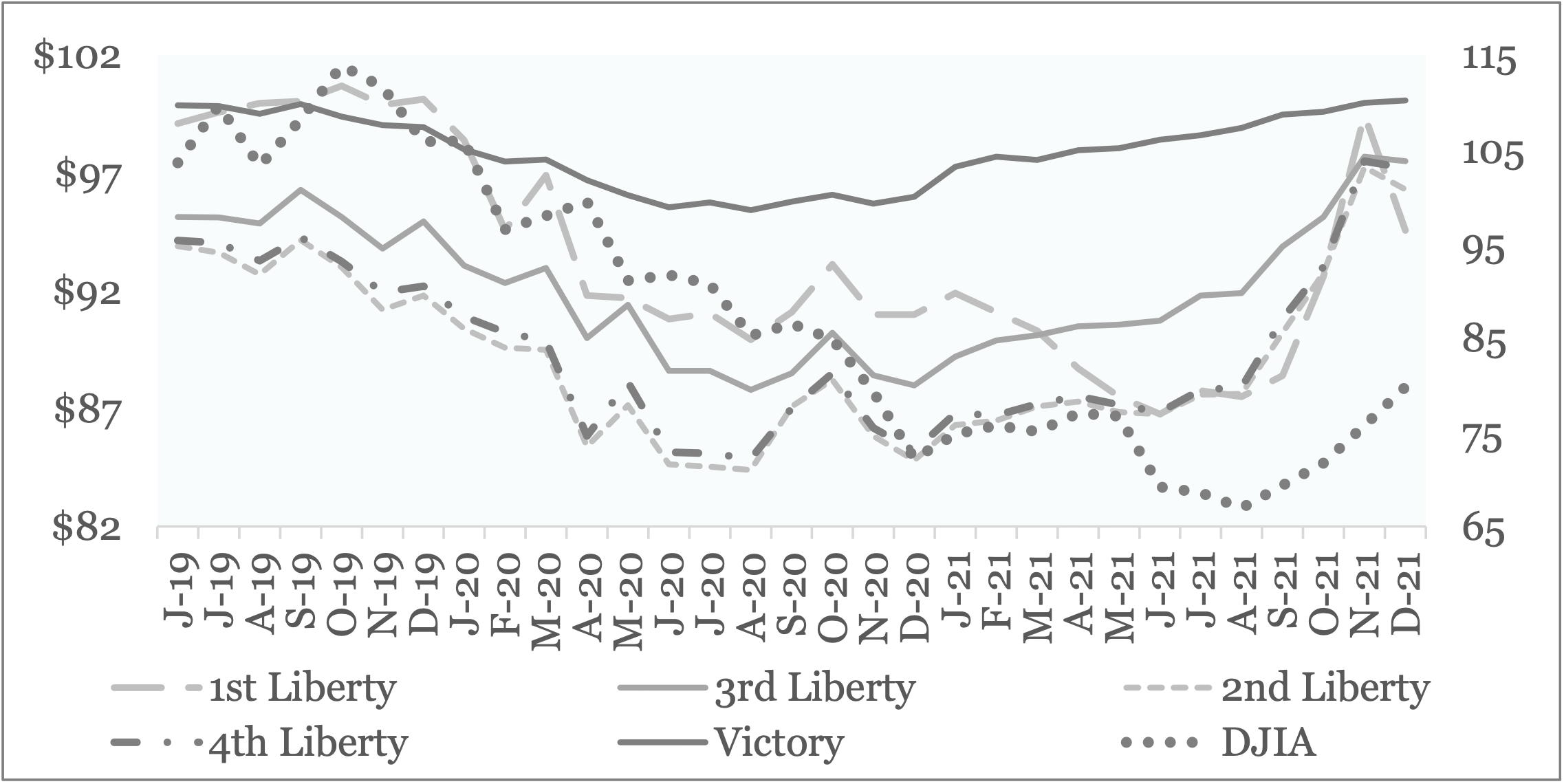
In turn, the withdrawal of credit drove a 46.6 percent decline in the DJIA (to 63.91) in the period to August 1921, when the prices of U.S. Government securities underwent a stunning contraction. Per Figure 3, from October 1919 to June 1921, the market price of the First Liberty Loan fell from $99.90 to $86.76. No small detail, the prices of U.S. Government securities were not revived until the Federal Reserve Banks introduced open market operations, its principal tool for conducting monetary policy today. The latter were notably launched in connection with the refunding of the Victory Loan that commenced in June 1921, approximately two years before its stated maturity, during which nine different offerings of Treasury Notes were made to reduce the outstanding balance.[4] It was the first government issue that was not refunded into securities bearing a long-term duration.
Figure 3. Market Price of U.S. Government Bonds vs. DJIA
Source: Financial Chronicle, FRED.
Putting aside the retrenchment in commercial lending, which prompted the unwinding of inventories that stoked the deflation for which it is best known, the episode is memorable because of the provenance of the overhang, namely, U.S. government securities.[5] Quite clearly, the proliferation of IPO crowded out the U.S. Treasury offering that, in turn, forced a repricing of U.S. Government debt.[6] Foreshadowing the upheaval in 1937 and 1973, one observes a glut of U.S. Government securities in competition with corporate IPOs. Among the steepest drops in any dataset, these precedents demonstrate what can go horribly wrong with stock prices when the risk-free rate, upon which all others are built, suddenly rises. It is representative of the fallout that an investor can anticipate from the kind of system-wide redemption of stablecoins that one should expect in the event of a collapse in cryptocurrencies. But of course, it is always possible that this time really is different.
Charles Lister Smith, PhD
July 10, 2026
[1] Federal Reserve Board, Annual Report for 1919 (Government Printing Office, 1920), 13.
[2] Federal Reserve Board, Annual Report for 1919, 12.
[3] The FRB described the situation, saying: “Fortunately the condition of the Treasury is such that the Board can now feel free to inaugurate discount policies adjusted to peacetime conditions and needs. The large volume of Government bonds looking for permanent ownership during the year was, however, an important factor in the situation and retarded the adoption of a normal discount policy. Until the absorption of Liberty bonds is fairly complete the Federal Reserve System will be in a transition stage and normal banking policies cannot be made entirely effective” (FRB, Annual Report for 1919, 70). Recorded confidentially, Governor Benjamin Strong also observed: "In 1919, for practically the entire year, and with increasing insistence in the autumn, the Federal Reserve Bank of New York advised and urged rate advances. The Board never approved our doing so” (Benjamin Strong, “Memorandum on the Chicago Rate Controversy, 1927,” Papers of Benjamin Strong, Jr., Federal Reserve Bank of New York, 18).
[4] When stating the objective of open market operations in April 1922, FRBNY Governor, Benjamin Strong wrote Treasury Undersecretary, Parker Gilbert, explaining: “Our purposes have been: (1) to facilitate the Treasury’s program of borrowing by exerting an influence toward a generally lower level of interest rates; (2) to replace discounts repaid by borrowing banks with short-tine investments in order, on the one hand, that we might maintain some reasonable earnings, but with the primary purpose that we might have a combined loan investment account sufficient at a later date when it became necessary to prevent dangerously low rates in the market and check unwholesome speculation; (3) to establish a level of interest rates, or at least to maintain rates at a level, which would facilitate foreign borrowing in this country” (Lester V. Chandler, Benjamin Strong: Central Banker (The Brookings Institute, 1958), 210-211).
[5] As it was commented in Atlanta: “A great number of the member banks in our district are carrying large amounts of war paper for their customers, and it is not very likely that this class of paper will be totally cleared up for several years, unless there is a reaction in business and other investments” (Federal Reserve Board, Annual Report for 1919, 391).
[6] The interpretation advanced here is novel. In the absence of any convincing explanation, the consensus has formed around Friedman and Schwartz (1963), who uphold the episode as a prime example of central bank authority and admonish policymakers for acting not only late, but also too severely in the tightening cycle. Even accounts that foreground the U.S. Treasury, like Meltzer (2003, 85-86), depict debt management as a mere constraint on monetary policy, making no mention of the Victory Loan, much less its bearing on the IPO markets. Far rather, policy missteps center on the financing arrangement imposed on banks by the U.S. Treasury, which frontloaded the payment of proceeds by leveraging the discount window in a manner that poured capital into the financial markets. Meanwhile, the Victory Loan was responsible for an increase in Government deposits of $4.5 billion across the period that caused a gyration in the money supply outside the control of monetary authorities. Like water, capital must find a home, and if a large portion is not to end up in the securities markets, then where?